



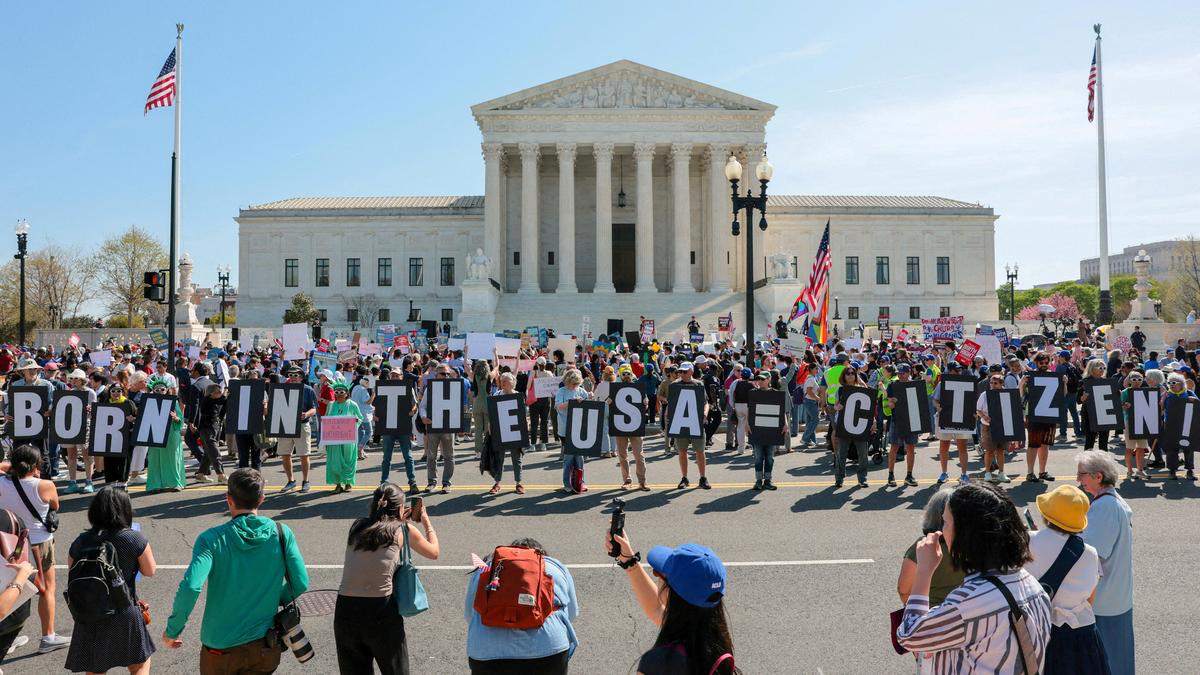
U.S. Supreme Court Upholds Birthright Citizenship, Dealing a Blow to Trump’s Immigration Agenda
The U.S. Supreme Court has upheld the constitutional principle of birthright citizenship, rejecting an attempt by President Donald Trump’s administration to limit automatic citizenship for children born on American soil. The ruling marks a significant moment in the ongoing legal and political battle over immigration, reaffirming one of the most enduring principles of the U.S. Constitution while dealing a setback to one of Trump’s signature immigration proposals.
The executive order, signed by Trump on the first day of his second term, sought to restrict birthright citizenship for children born in the United States to parents who were either in the country illegally or on temporary visas. The administration argued that the policy was necessary to curb illegal immigration and discourage what critics describe as “birth tourism.”
However, the Supreme Court’s decision reinforces the long-standing interpretation of the 14th Amendment, which guarantees that virtually every person born in the United States is automatically an American citizen, regardless of their parents’ immigration status.
A Constitutional Principle That Has Survived More Than a Century
Birthright citizenship has been a cornerstone of American constitutional law since the adoption of the 14th Amendment in 1868. The amendment declares that “all persons born or naturalized in the United States, and subject to the jurisdiction thereof, are citizens of the United States.”
Its modern interpretation was firmly established by the Supreme Court in the landmark 1898 case United States v. Wong Kim Ark, which held that a child born in the United States to foreign parents was entitled to American citizenship.
Legal experts have long argued that altering this principle would require a constitutional amendment or a dramatic reinterpretation by the Supreme Court itself—not merely an executive order issued by the President.
By rejecting Trump’s proposed restrictions, the Court has effectively reaffirmed decades of constitutional precedent and underscored that executive authority has clear constitutional limits.
Supporters of the ruling argue that constitutional protections cannot be altered based on changing political priorities. They contend that birthright citizenship provides legal certainty, prevents statelessness, and reflects America’s historical commitment to equal protection under the law.
Opponents, however, believe that automatic citizenship acts as an incentive for illegal immigration and places additional burdens on public resources. They argue that Congress should revisit immigration laws to address concerns surrounding border security and unauthorized migration.
Immigration Debate Far From Over
Although the Supreme Court has settled the constitutional question for now, the political debate surrounding immigration is unlikely to fade.
Immigration remains one of the most polarising issues in American politics. Trump’s administration has made border security, deportations, and stricter immigration enforcement central to its agenda. Limiting birthright citizenship formed part of a broader effort to tighten immigration policies and reduce what the administration considers incentives for unlawful entry into the country.
The Court’s decision highlights the delicate balance between presidential authority and constitutional safeguards. While the executive branch possesses significant powers over immigration enforcement, those powers remain subject to constitutional constraints and judicial review.
The ruling also sends a broader institutional message. It demonstrates that even during periods of intense political division, constitutional interpretation ultimately rests with the judiciary rather than the executive branch.
For immigrant communities, the judgment provides clarity and reassurance regarding the citizenship status of children born in the United States. For policymakers, it reinforces that meaningful changes to citizenship law would require legislative action or constitutional reform rather than unilateral executive action.
As the United States heads deeper into another politically charged period, immigration will almost certainly remain at the centre of national debate. Border security, asylum policy, legal immigration, and citizenship laws will continue to divide political leaders and voters alike.
The Supreme Court’s decision may have resolved one constitutional question, but it has not ended the broader national conversation over how America should define its immigration system. Instead, it underscores a fundamental principle of American democracy: while governments change, constitutional protections remain far more difficult to alter than political promises.

NewsHasghag operates a 24/7 news bureau that tracks the real-time, social media-driven stories from India and around the world, keeping you ahead of the day’s key talking points. Our digital-first approach transforms storytelling through the seamless integration of data, interactive charts, video, and audio into every narrative