






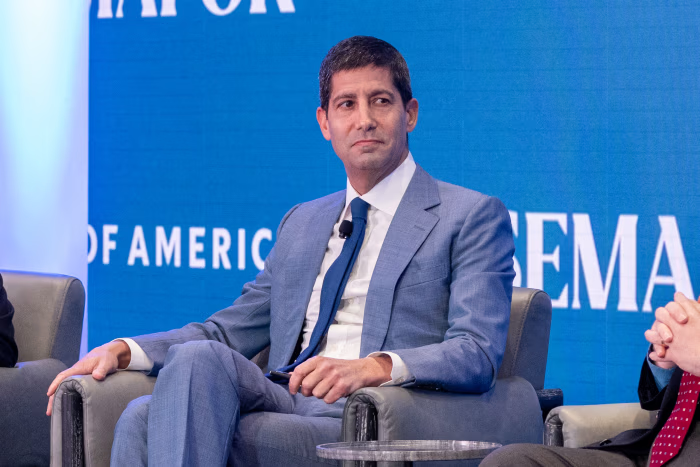
Kevin Warsh the Architect of a New Monetary Regime has amongst few names carry as much weight today as Kevin Warsh. On January 30, 2026, President Donald Trump officially nominated the former Federal Reserve Governor to succeed Jerome Powell as the Chair of the Federal Reserve. This move marks a historic shift in U.S. monetary policy, signaling a transition from the “data-dependent” era of Powell to what many call the “productivity-led” era of Warsh.
Who is Kevin Warsh?
Born in 1970 in Albany, New York, Kevin Maxwell Warsh is a financier, bank executive, and economic scholar who has spent his career at the intersection of Wall Street and Washington. He is often described as having “central casting” qualities—a blend of polished market fluency and deep institutional knowledge.
Warsh’s academic pedigree is formidable. He earned his A.B. in Public Policy with honors from Stanford University in 1992, followed by a J.D. (cum laude) from Harvard Law School in 1995. During his studies, he focused heavily on the intersection of law, economics, and regulatory policy, even completing specialized coursework at MIT’s Sloan School of Management and Harvard Business School.
Kevin Warsh: Professional Journey From Morgan Stanley to the Fed
Warsh began his career in the Mergers and Acquisitions department at Morgan Stanley & Co., where he rose to the position of Executive Director. In 2002, he left Wall Street for the White House, serving as Special Assistant to President George W. Bush for Economic Policy and Executive Secretary of the National Economic Council.
In 2006, at the age of 35, Warsh became the youngest person ever appointed to the Federal Reserve Board of Governors. During the 2008 Global Financial Crisis, he became Ben Bernanke’s “bridge to Wall Street,” serving as a critical liaison between the government and the world’s largest banks. Since leaving the Fed in 2011, he has served as a Distinguished Visiting Fellow at the Hoover Institution and a lecturer at Stanford Graduate School of Business.
Market Impact: Why His Nomination Shook the World
The announcement of Warsh as the next Fed Chair triggered immediate and violent moves across global asset classes. His reputation as an “inflation hawk” who is now open to “aggressive rate cuts” has created a unique duality in market sentiment.
The Gold and Dollar Reversal
Warsh’s nomination acted as a “credibility anchor” for the U.S. Dollar. Before his name emerged, the dollar was in a cyclical decline, fueling a parabolic rise in Gold. However, because Warsh is known for his skepticism of a “bloated Fed balance sheet,” his appointment led to a massive profit-booking event in precious metals. Gold saw one of its sharpest single-day drops as investors priced in a leader who would prioritize currency credibility over endless stimulus.
The “AI Productivity” Narrative
Warsh has been vocal about his belief that the Artificial Intelligence revolution is a disinflationary force. He argues that AI-driven productivity gains allow the economy to grow faster without triggering inflation, which justifies lower interest rates even in a strong economy. This has shifted investor focus toward “Real Assets” and technology-heavy indices.
Restoring Institutional Independence
For the markets, Warsh represents a “regime change.” He has criticized the Fed’s recent “mission creep” into political areas and has called for a return to a narrower focus on price stability. His presence is expected to reduce the Fed’s reliance on “forward guidance,” which may lead to higher short-term market volatility but more sustainable long-term growth.
What Investors Should Watch
As Kevin Warsh prepares for his Senate confirmation, investors should brace for a “Run-it-Hot” economy. His framework suggests a Fed that is simultaneously more disciplined with its balance sheet but more flexible with interest rates.
For your portfolio, this means a shift away from “speculative liquidity” toward productive capital. Stocks in infrastructure, AI, and banking (like ICICI Bank) stand to benefit from his “supply-side optimism.” While he may have “scared off the gold bulls” for a moment, his tenure promises a more orthodox and predictable Federal Reserve, which could be the ultimate stabilizing force the global markets need in 2026.
Also Read: https://newshashtag.com/global-market-outlook-2026/

Prerna Varshney is a journalist and social commentator with over five years of experience in health, gender, and policy reporting. Her work reflects a deep commitment to truth and empathy, simplifying complex issues for everyday readers.