


Trade Diplomacy and Global Capital Pivot: Indian Equities Surge on Landmark U.S. Deal
MUMBAI – Trade Diplomacy and Global Capital Pivot: Indian Equities Surge on Landmark U.S. Deal when Dalal Street witnessed a decisive shift in momentum during early trade on Wednesday, as the Indian equity markets shook off recent post-Budget jitters to embrace a new era of strategic alignment. The benchmark BSE Sensex and NSE Nifty 50 advanced steadily, fueled by a dual engine of fresh foreign institutional investor (FII) inflows and a transformative trade agreement between India and the United States.
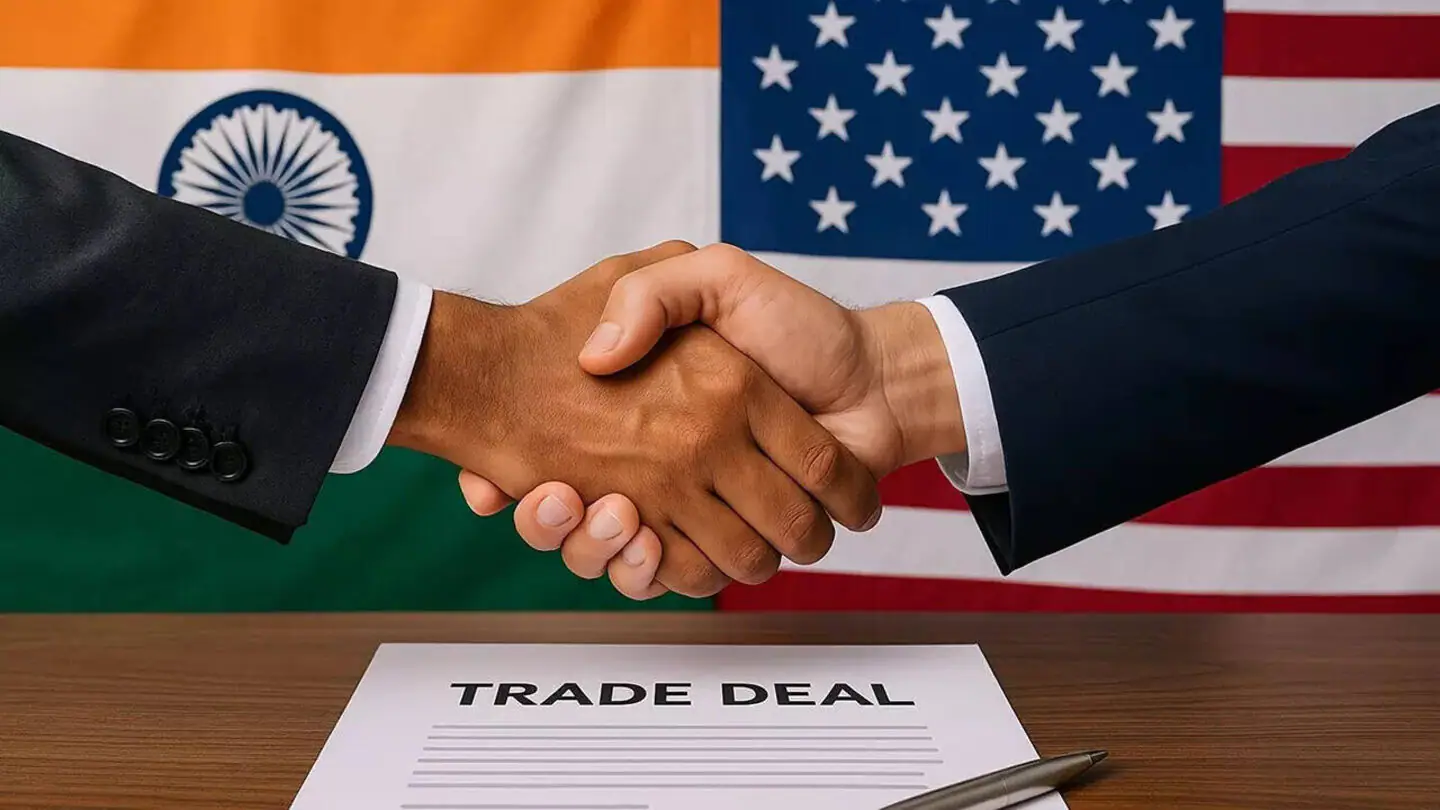
The center of gravity for this rally is the landmark India-U.S. trade pact announced late Tuesday. Under the new framework, Washington has agreed to slash reciprocal tariffs on Indian goods from a staggering 50%—a legacy of 2025’s punitive measures—down to 18%. In exchange, New Delhi has committed to a $500 billion investment roadmap into the U.S. economy, spanning energy, technology, and agriculture, while signaling a gradual pivot away from Russian energy dependencies.
The “Big Six” Lead the Charge
The market’s response was led by the “old guard” of the Sensex, with heavyweights across the automotive, energy, and financial sectors seeing concentrated buying.
Mahindra & Mahindra (M&M) emerged as a primary beneficiary, surging nearly 2% in early deals. The automaker is uniquely positioned to capitalize on reduced export friction, coming off a record-breaking month for tractor and utility vehicle sales. Close on its heels was Power Grid Corporation, which continues to ride a wave of bullish sentiment following its upgraded FY26 capital expenditure guidance of ₹32,000 crore.
Energy giants Reliance Industries (RIL) and NTPC also provided significant heft to the indices. For Reliance, the deal offers a clearer path for its burgeoning “New Energy” exports to Western markets. Meanwhile, ICICI Bank and ITC rounded out the top gainers, reflecting a broader risk-on sentiment among domestic and foreign investors who see the trade pact as a stabilizer for the Indian Rupee and a catalyst for credit growth.
FIIs Return to the Fray
Perhaps the most significant “under-the-hood” development is the sudden reversal in foreign fund movement. After a year dominated by “selling on every rise,” Foreign Institutional Investors turned net buyers on February 3, pumping over ₹5,236 crore into the cash market in a single session.
“The trade deal effectively removes the ‘Russia-linked’ overhang that had kept global funds on the sidelines,” noted a senior institutional strategist. “By bringing tariffs down to 18%, India is no longer an outlier in the global trade hierarchy. We are seeing a structural reallocation of capital from other emerging markets back into Indian large-caps.”
A Bifurcated Market
Despite the euphoria, the rally remained selective. While the “Sensex Firms” mentioned above thrived, the IT sector faced a sharp localized rout. Heavyweights like Infosys and TCS slumped as much as 5% in early trade, tracking a tech sell-off on Wall Street and concerns over how the new trade framework might affect H-1B visa norms and service-sector outsourcing costs.
The BSE IT index tumbled nearly 5%, acting as a drag that prevented the Sensex from achieving a runaway 1,000-point gain. However, for most market participants, the day marked a “narrative reset.”
The Road Ahead
As the trading session progresses, all eyes remain on the implementation timeline of the 18% tariff cap. While the immediate sentiment boost is undeniable, analysts warn that the “devil will be in the details” regarding energy costs if India accelerates its shift from discounted Russian crude to higher-priced American alternatives.
For now, the story of February 4 is one of relief. With a major geopolitical hurdle cleared and FIIs reaching for their checkbooks, the Indian market seems ready to move past the volatility of the January Budget and look toward a more integrated global future.