






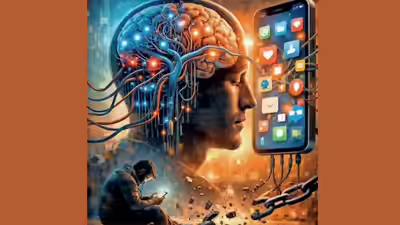
Is Your Phone Rewiring Your Brain?
Is Your Phone Rewiring Your Brain- is a great question- everybody must answer it.
The modern smartphone is no longer a mere tool; it has become an external lobe of the human brain. While these devices offer unprecedented access to information, a growing body of neuroscientific research suggests that the cost of this connectivity is a fundamental structural and functional rewiring of our most vital organ. From the way we process memories to our capacity for sustained attention, the digital interface is decisively altering the human experience.
The Fragmentation of Attention and “Attention Residue”
The human brain is not naturally wired for multitasking; it is designed for monotropic focus. Every notification—the subtle vibration of a message or the blue light of a social media alert—triggers a “task-switching cost.”
Neuroscientists refer to this as “attention residue.” When we pivot from a deep task to check a phone, a portion of our cognitive resources remains stuck on the previous activity. This prevents us from entering a “flow state,” the psychological zone where high-level problem-solving occurs. Over time, chronic “snacking” on digital content trains the brain to crave constant novelty, weakening the prefrontal cortex’s ability to maintain long-term focus.
The Dopamine Loop and Reward Circuitry
At the heart of our phone engagement is a dopamine-driven feedback loop. Apps are engineered using “variable reward schedules,” the same psychological mechanism found in slot machines. Because we do not know when the next “like,” email, or news headline will appear, we are compelled to check our devices compulsively.
This constant stimulation can desensitize the brain’s reward system. As the baseline for what constitutes a “rewarding” stimulus rises, mundane reality—reading a book, having a long conversation, or sitting in silence—starts to feel painfully boring. This rewiring leads to a state of “digital restlessness,” where the brain remains in a perpetual state of seeking rather than reflecting.
Digital Amnesia and the “Google Effect”
The way we store information has also undergone a radical shift, a phenomenon often called “Digital Amnesia.” Because the brain is a highly efficient machine, it tends to offload tasks it deems redundant. When we know that information is stored externally in a cloud or search engine, our brains are less likely to encode that information into long-term memory.
We are becoming proficient at remembering where to find information rather than the information itself. While this makes us efficient researchers, it often bypasses the “consolidation” phase of learning. Without a rich internal store of knowledge, our ability to make creative leaps and synthesize complex ideas is diminished. We risk becoming “pancake people”—spread wide and thin by access to vast information, but lacking depth of understanding.
The Social Brain and the Empathy Gap
Finally, the rewiring extends to our social circuitry. The nuances of human communication—tone of voice, facial expressions, and micro-gestures—are processed in real-time during face-to-face interactions. Smartphones often replace these high-bandwidth experiences with low-bandwidth text and emojis.
Studies suggest that heavy smartphone usage can be correlated with a decline in “cognitive empathy.” When the brain is shielded by a screen, it does not receive the immediate physiological feedback that occurs during a real-world social encounter. This creates a disconnect in the neural pathways responsible for emotional resonance.
The smartphone is an evolutionary double-edged sword. It offers us the world at our fingertips but threatens to hollow out the cognitive depth required to navigate that world meaningfully. To preserve the brain’s integrity, we must move toward “digital intentionality”—viewing the phone as a high-powered instrument for specific tasks, rather than a permanent appendage that dictates the architecture of our thoughts.

Prabha Gupta is a veteran journalist and civic thinker dedicated to the constitutional ideals of dignity and institutional ethics. With over thirty years of experience in public communication, her work serves as a bridge between India’s civil society and its democratic institutions. She is a prominent voice on the evolution of Indian citizenship, advocating for a national discourse rooted in integrity and the empowerment of the common citizen