






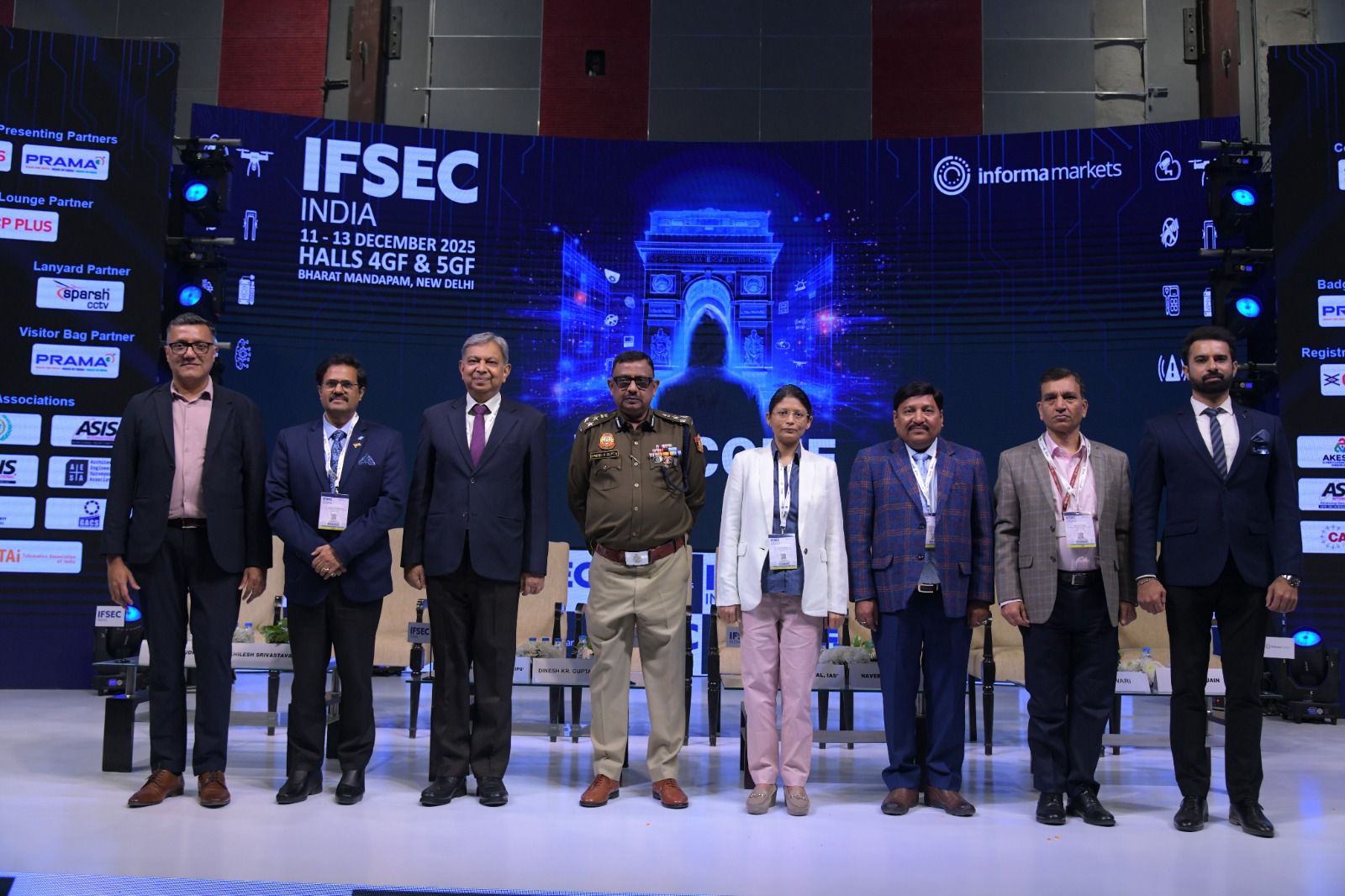
IFSEC India 2025 opened in New Delhi with a clear message: India’s security and surveillance framework is entering a decisive new decade. Senior government officials warned that cyberattacks, AI-driven threats, and new vulnerabilities across public infrastructure are rising far faster than earlier predicted. Yet the event also showcased India’s readiness to build a smarter, more resilient, and technology-driven security ecosystem.

India’s electronic security market is now moving rapidly toward the ₹1 lakh crore milestone. This growth powered by urbanisation, digital governance, and the expansion of public infrastructure has turned IFSEC India into one of the most important spaces where government priorities meet industry capabilities.
Why India’s Security Priorities Are Shifting
IFSEC India set the tone with strong statements from policymakers. They revealed that since major intrusions such as Operation Sindoor, government networks are now facing nearly seven times more cyberattack attempts. Ransomware groups, phishing networks, and supply-chain breaches have increasingly targeted ministries, citizen service platforms, and national data centres—making India’s digital backbone more exposed than ever.
Officials highlighted how artificial intelligence is reshaping the threat landscape. While AI is powering faster governance, public service delivery, and automated systems, the same technology is allowing attackers to create sophisticated malware, deepfake-based fraud, and intelligent intrusion tools. As AI becomes embedded in transport networks, identity systems, healthcare databases, and administrative platforms, India’s exposure to AI-accelerated threats will grow.
Another deep concern is quantum vulnerability. By 2028, several existing encryption systems could become ineffective as quantum capabilities expand globally. Experts cautioned that India must develop quantum-resilient frameworks now, before adversaries gain an upper hand. .
Why IFSEC India Matters and What the Next Decade Looks Like
The 2025 edition of IFSEC India is the largest ever, bringing together more than 150 exhibitors, 350 brands, and an expected 20,000 industry professionals. This scale mirrors the growing need for intelligent security across urban centres, transport systems, workplaces, logistics networks, and public institutions. I
ndustry leaders pointed out that demand for AI-powered surveillance is rising sharply in safe-city projects, metro networks, industrial zones, corporate campuses, and retail environments. India is gradually transitioning from traditional monitoring to cognitive security systems that not only record activity but also analyse patterns and forecast risks.
However, the event also revealed some critical challenges. One persistent issue is India’s dependence on imported surveillance hardware. High-end cameras, processors, sensors, and chips continue to come from foreign suppliers, leaving India vulnerable to international supply disruptions and potential security gaps. Policymakers argued that accelerating domestic electronics and semiconductor manufacturing must become a national priority if India hopes to build a sovereign, reliable security ecosystem.
Despite these concerns, IFSEC India underscored the positive momentum of international collaboration. Countries across Europe, the Middle East, and Southeast Asia are adopting AI-led security frameworks, and India is positioning itself within this global shift—while building localised, scalable, and cost-efficient solutions suited to its population and infrastructure.
Looking ahead to 2030, India is expected to deploy large-scale surveillance networks across major cities, airports, metro corridors, industrial hubs, and logistics routes. Corporate security teams will increasingly rely on deep-learning tools to detect anomalies in real time. Even mid-size enterprises will adopt cloud-based integrated security systems.
AI-driven command centres will become the backbone of urban safety, merging feeds from drones, transport networks, emergency systems, and public safety databases. As India’s digital economy expands, these intelligent centres will help prevent threats rather than merely respond to them.

Prabha Gupta is a veteran journalist and civic thinker dedicated to the constitutional ideals of dignity and institutional ethics. With over thirty years of experience in public communication, her work serves as a bridge between India’s civil society and its democratic institutions. She is a prominent voice on the evolution of Indian citizenship, advocating for a national discourse rooted in integrity and the empowerment of the common citizen