






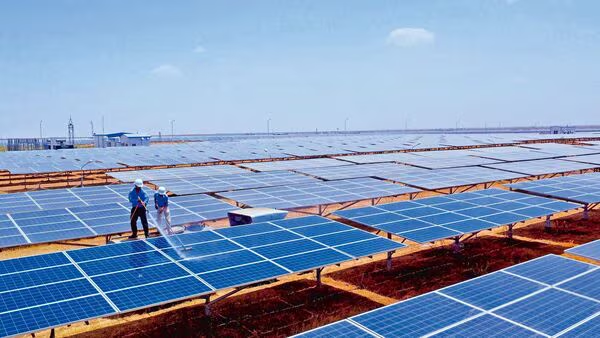
India’s renewable energy ambitions are rising faster than the country’s ability to carry that energy across the national grid. In the past few months, major producers—Adani Green Energy, JSW Energy, and NTPC Green Energy—have been forced to curtail solar power generation because transmission lines simply could not absorb the electricity being produced. This comes at a time when India is pushing aggressively toward a 500-GW renewable target by 2030, raising fundamental questions about whether generation is expanding faster than the system that must support it.
The situation represents a paradox: India finally has abundant clean energy, but an inadequate grid system is preventing that power from reaching consumers. Behind the headlines lies a deeper problem—one that threatens the economics of solar power, investor confidence, and the reliability of India’s long-term green transition.
The Renewable Boom Meets a Crumbling Grid
States like Rajasthan, Gujarat and Karnataka, where solar capacity has exploded, now face an ironic constraint: more sunshine than the grid can handle. Developers have commissioned large solar parks, but the transmission upgrades required to evacuate this power lag by months—sometimes years.
As a result, grid operators issue “back-down” orders, instructing companies to cut solar output to prevent overload. Sources indicate that in peak sunshine months, several utility-scale plants saw curtailments of 10–20%, directly impacting revenues and investor returns.
For companies like Adani Green, whose massive 30-GW renewable portfolio relies on scaling efficiencies, curtailment means expensive and unpredictable financial losses. JSW Energy, which is pivoting heavily toward renewables, faces similar setbacks. Even NTPC Green, backed by India’s largest power producer, is experiencing interruptions that undermine the reliability of the sector.
Developers argue that they followed timelines and invested billions, but the grid did not keep pace. With each curtailment, India loses cheap, clean electricity—only to rely more heavily on coal to fill the gap.
Policy Mismatch and the Road Ahead
The heart of the crisis lies in a misalignment between policy ambition and structural readiness. Solar capacity additions are fast; grid expansion is slow. Central government agencies like Power Grid Corporation have stepped up investments, but bureaucratic delays, land acquisition hurdles, and slow state approvals mean transmission infrastructure often trails capacity installations by years.
International investors, who once viewed India as a solar powerhouse, are quietly reassessing risks. A renewable plant that cannot export electricity becomes financially unstable, undermining the premise of India’s green transition.
To resolve this mismatch, India needs urgent steps:
— Faster right-of-way clearances
— Integrated planning linking solar parks with evacuation corridors
— Stronger state coordination with central agencies
— Investment in smart-grid technologies to absorb variable power
If these fail to materialize, India’s renewable sector may continue producing “too much power” for a system with “too little grid” to carry it.
A Moment of Reckoning
The forced solar shutdowns at Adani, JSW, and NTPC signal a critical moment in India’s clean-energy story. The country has learned how to generate renewable energy at record-low costs. The next challenge—and perhaps the real test of commitment—is whether it can build a transmission backbone capable of carrying that energy safely and efficiently.
Until grid infrastructure catches up, India’s remarkable solar success will remain constrained by an outdated system. The nation may be producing more power than ever, but unless that power can travel, the future of its renewable revolution will continue to flicker between promise and uncertainty.

NewsHasghag operates a 24/7 news bureau that tracks the real-time, social media-driven stories from India and around the world, keeping you ahead of the day’s key talking points. Our digital-first approach transforms storytelling through the seamless integration of data, interactive charts, video, and audio into every narrative