

Why Modi visited Israel second time? India is asking this question
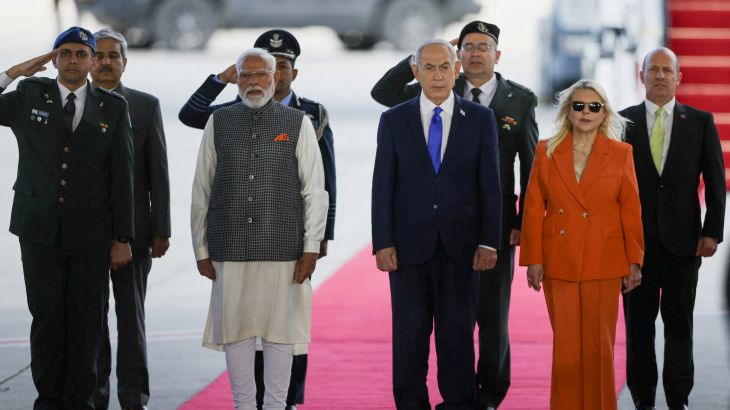
Why Modi visited Israel second time? Prime Minister Narendra Modi’s second visit as Prime Minister comes at a moment of sharp geopolitical tension and renewed domestic debate. At the centre of the conversation is a proposed “Hexagon Alliance,” an idea attributed to Israeli Prime Minister Benjamin Netanyahu that reportedly envisions a strategic grouping involving Israel, Greece, Cyprus, select African nations and potentially India. While the alliance remains conceptual, speculation about India’s possible role has triggered a broader question: what does India truly gain from deepening its embrace of Israel — and what might it be conceding in return?
For years, India Israel ties have been framed as a success story of strategic convergence. Defence cooperation, intelligence sharing, agricultural technology and cybersecurity partnerships are often cited as pillars of a mature relationship. Yet beneath the celebratory tone lies a more complicated geopolitical calculus.
Strategic Gains or Strategic Dependence?
Supporters of closer ties argue that Israel offers India cutting-edge defence systems, surveillance technology and counter-terror expertise — assets deemed critical given India’s security challenges from Pakistan and China. The recurring claim is that as China and Pakistan strengthen their own strategic coordination, India must widen its security partnerships.
However, critics ask whether this alignment has translated into tangible diplomatic backing during India’s moments of crisis. During confrontations with China from Doklam to Galwan — Israel did not emerge as a visible geopolitical counterweight. The partnership appears robust in arms sales and technology transfers, but less evident in overt diplomatic support against Beijing.
Controversies such as the Pegasus spyware revelations also cast a shadow. The Israeli-developed surveillance tool allegedly used against journalists and opposition leaders in India complicated the narrative of an unambiguously beneficial partnership. Instead of reinforcing democratic safeguards, critics argue, such technologies risk deepening internal political fault lines.
The debate widened further when opposition leaders referenced email exchanges dating back to 2017 involving businessman Anil Ambani, former diplomat Hardeep Singh Puri and the late Jeffrey Epstein. According to political allegations, the correspondence discussed meetings with senior figures in the Trump administration around the time of Modi’s first Israel visit. While these claims remain politically contested, they intensified scrutiny over transparency in foreign policy decision-making and the role of private intermediaries.
In parallel, discussions about Israel’s Iron Dome missile defence system have resurfaced, with speculation that India could eventually gain access to advanced variants or co-production arrangements. Although no formal announcement has confirmed such a transfer, the very possibility fuels domestic narratives portraying Israel as a uniquely reliable strategic partner. Yet even the Iron Dome’s battlefield performance — including recent analyses in Western media about its limitations under sustained missile barrages — suggests that technological superiority alone does not eliminate strategic vulnerability.
Regional Signalling and the Iran Question
Modi’s visit unfolds amid heightened tensions involving Iran, a country with which India shares longstanding civilisational, energy and infrastructure ties. Projects like the Chabahar port symbolised India’s attempt to maintain strategic autonomy in West Asia. But escalating confrontation between Iran, Israel and the United States complicates this balancing act.
A high-profile Israeli visit during such volatility inevitably carries symbolic weight. Even if India maintains formal neutrality, optics matter in diplomacy. Tehran may interpret closer visible alignment with Israel as strategic drift. Meanwhile, Israel’s proposed Hexagon Alliance described by Netanyahu as a counterweight to regional “radical axes” — appears designed to reshape West Asian security architecture in ways that may not fully align with India’s historical non-aligned posture.
Global opinion on Israel’s conduct in Gaza and the West Bank has also shifted significantly. Accusations of disproportionate force, humanitarian devastation and prolonged occupation have intensified debates within Europe and the United Nations. India has traditionally supported a two-state solution and engaged both Israel and Palestine. But its recent diplomatic calibrations have prompted discussion about whether New Delhi is redefining that equilibrium.
There is also the broader question of whether increasing defence procurement from Israel risks creating long-term dependence on a single supplier’s security ecosystem. Strategic autonomy — long a cornerstone of Indian foreign policy rests on diversified partnerships rather than concentrated reliance.
None of this suggests that India should disengage from Israel. Bilateral ties between sovereign nations are neither inherently virtuous nor inherently suspect; they are instruments of national interest. The real issue is transparency and proportionality. Are the benefits measurable, the risks acknowledged, and the trade-offs publicly debated?
Foreign policy often operates in grey zones of pragmatism and symbolism. Yet democratic accountability requires that major strategic shifts withstand scrutiny beyond celebratory headlines. As Prime Minister Modi meets Israeli leaders and addresses their parliament, observers will watch not only for diplomatic warmth, but for signs of how India intends to balance security cooperation with regional stability, ethical positioning and its long-standing doctrine of strategic autonomy.

Prabha Gupta is a veteran journalist and civic thinker dedicated to the constitutional ideals of dignity and institutional ethics. With over thirty years of experience in public communication, her work serves as a bridge between India’s civil society and its democratic institutions. She is a prominent voice on the evolution of Indian citizenship, advocating for a national discourse rooted in integrity and the empowerment of the common citizen