




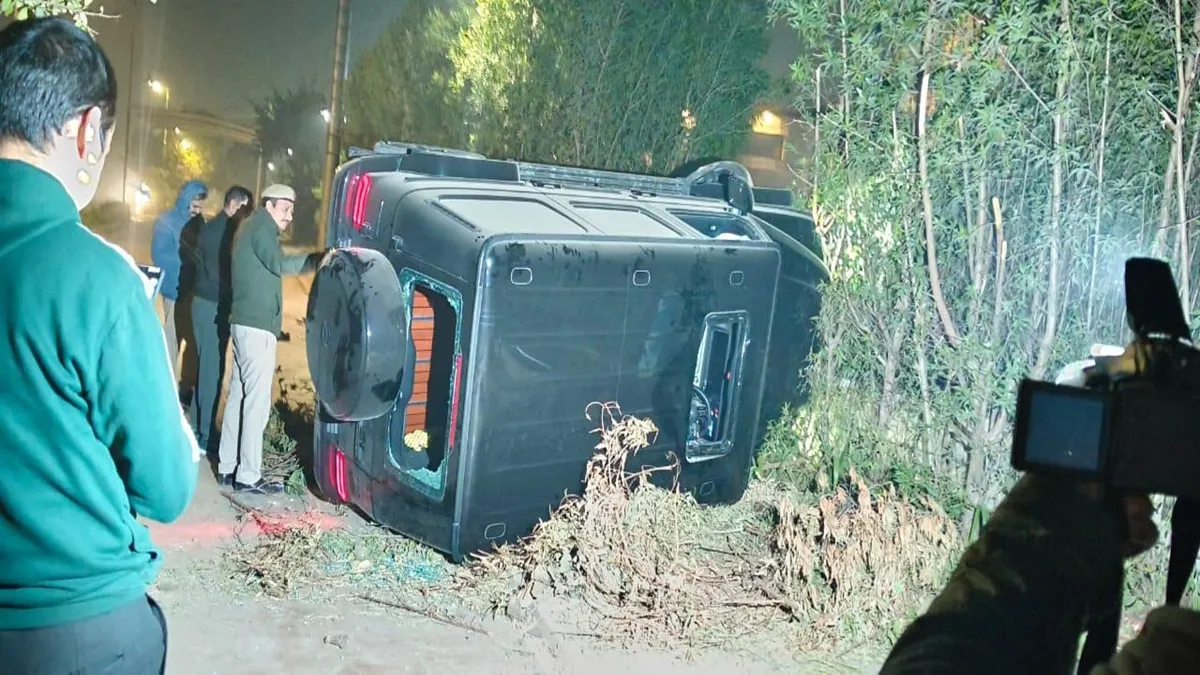
Mercedes Crash Kills One on Vasant Kunj Footpath
A late-night tragedy in Delhi’s Vasant Kunj has once again exposed the deep gaps in the city’s policing and urban safety. A speeding Mercedes ran over people sleeping on a footpath near Kishangarh, killing one labourer and critically injuring others. The driver fled immediately. Eyewitnesses told reporters that the car moved “as if the road was empty,” creating shock and panic before disappearing into the dark.
The incident raises a simple but urgent question: How does a high-end vehicle race unchecked through a residential stretch where footpaths double as sleeping spaces for the poor? And where exactly was the patrolling police when the crash occurred?
Overspeeding, Dark Stretches, and a Repeated Pattern
Initial accounts suggest the Mercedes was travelling far above the permissible speed. Residents say the stretch has become a late-night racing corridor because it remains poorly lit and rarely monitored. The absence of functional CCTV cameras in key points means the exact speed, route, and driver behaviour remain unclear. Delhi has recorded similar cases in recent years—from the Kanjhawala dragging case to the Dwarka overspeeding crashes—yet enforcement on night driving shows little improvement.
Overspeeding remains the single biggest cause of road deaths in the city. In areas like Vasant Kunj, where labourers sleep along pavements near construction sites, even a moment of rash driving turns deadly. While footpaths are meant for pedestrians, the lack of affordable housing forces thousands to use them as shelter. This structural reality makes the need for night policing even more critical.
Where Was the Patrolling Police?
Residents claim they rarely see a police patrol between midnight and 4 am, except at designated checkpoints far from the residential lanes. The exact time of the crash—past midnight—falls within the window when visibility is low, traffic is sparse, and enforcement is weakest. Police officials later stated that a patrol unit was deployed in the broader Vasant Kunj division, but it was not present at the exact location when the crash occurred.
This absence is not accidental; it reflects a systemic pattern. Night patrolling in Delhi often focuses on drunk-driving barricades at main intersections, leaving internal roads unmonitored. Speed checks almost never take place after 11 pm. The lack of real-time surveillance, poorly placed CCTV cameras, and minimal street lighting further reduce police visibility and response time.
By the time help arrived, the driver had escaped and the witnesses were left scrambling to pull injured men out from under the crushed bedding. The city’s slow emergency response time added to the damage.
A City Where the Poor Sleep on Footpaths and the Rich Drive Without Restraint
This incident is not just about one speeding Mercedes. It reflects the contrasting realities of urban India—where construction workers have no option but to sleep on walkways, while luxury cars move through the same streets at uncontrollable speeds. Delhi’s urban design has failed the vulnerable repeatedly. In winter, when migrant workers sleep outdoors due to overcrowded shelters, accidents spike sharply.
Strict enforcement at night is the only way to prevent such tragedies. Other global cities handle this by expanding patrol units after midnight, installing automatic speed cameras, and increasing lighting in residential corridors. Delhi’s approach remains reactive; action happens after a tragedy, not before it.
As investigations continue, the Vasant Kunj crash stands as another reminder that infrastructure, policing, and policy must work together. Without that coordination, the city will continue to witness preventable deaths on pavements that should have remained safe.

NewsHasghag operates a 24/7 news bureau that tracks the real-time, social media-driven stories from India and around the world, keeping you ahead of the day’s key talking points. Our digital-first approach transforms storytelling through the seamless integration of data, interactive charts, video, and audio into every narrative