

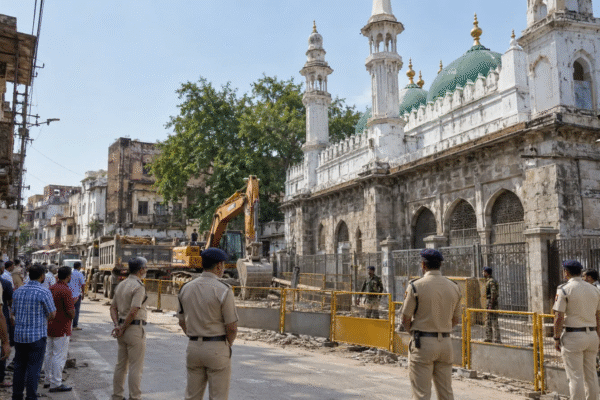
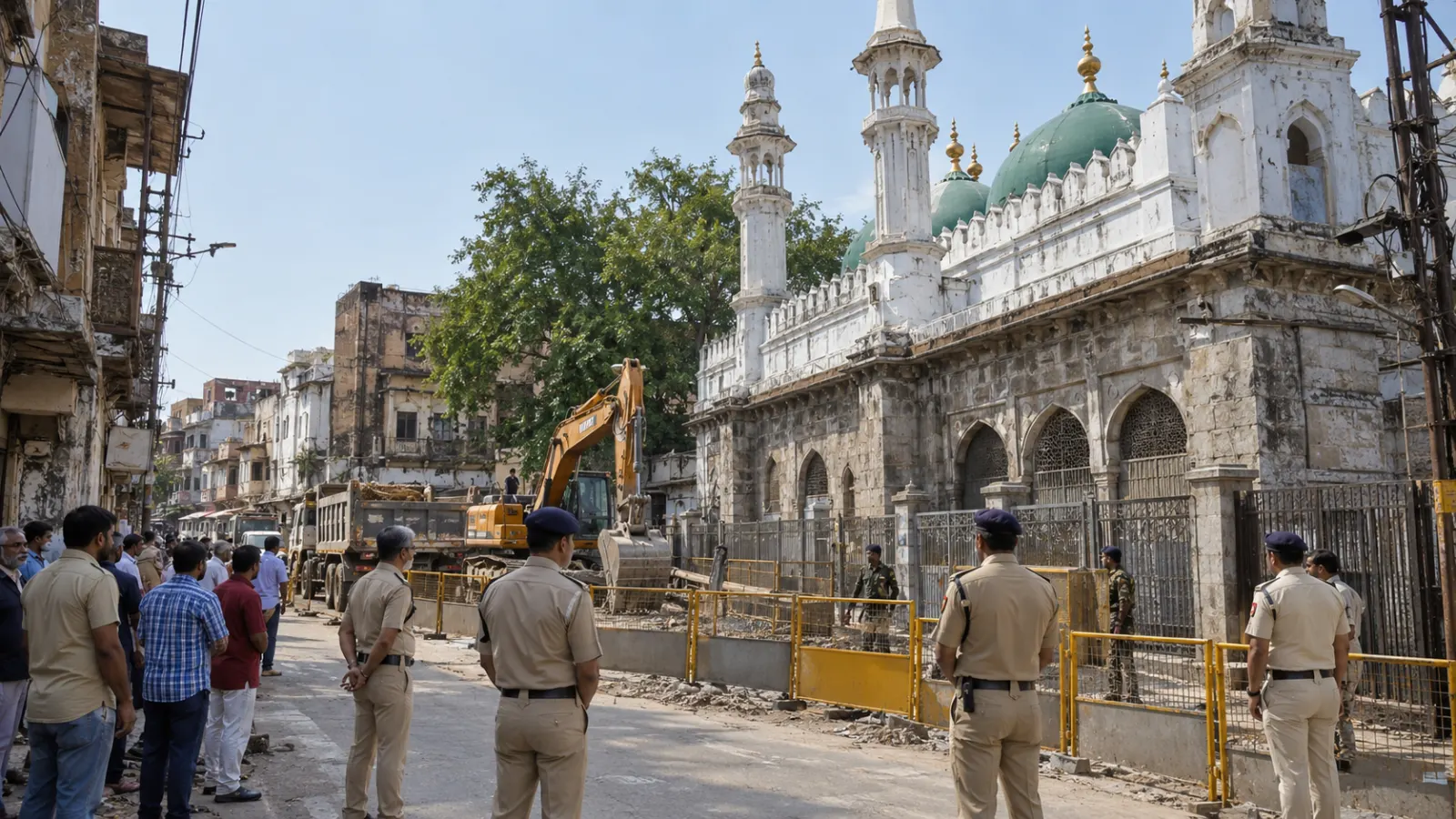
The controversy over Ujjain’s Shahi Masjid, which had escalated into a dispute over religious rights, road widening and public infrastructure, took a new turn on September 28 after the Madhya Pradesh High Court disposed of an appeal following a settlement between the mosque’s authorised administrative committee and the Ujjain Municipal Corporation.
The development came against the backdrop of tension at the mosque as civic authorities moved to remove the portion falling within the proposed road alignment. The road-widening project is linked to preparations for the Simhastha Kumbh 2028, when Ujjain is expected to witness a major increase in traffic and pedestrian movement. The controversy, however, began well before Monday’s settlement.
How the Ujjain Shahi Masjid dispute began
The Ujjain Municipal Corporation proposed widening the road to 15 metres in the area around the Shahi Masjid. According to the September 9 order of the Madhya Pradesh High Court’s Indore Bench, the proposed action would affect part of the mosque’s Jamat Khana or prayer hall, a 120-foot-high minaret and the Mazhar Chouk Shahi. The mosque is registered as a Waqf property.
The mosque administration challenged a series of municipal notices issued in August and a final notice/order dated September 1, 2026. The petitioners argued that the structure was an ancient religious property and that removal of its important portions would affect constitutionally protected rights under Articles 14, 25 and 26. They also questioned whether alternative properties or routes could be used for road widening.
The municipal authorities, however, maintained that the road-widening exercise was being undertaken under the Ujjain Development Plan, 2035 and in the larger public interest. The High Court, in its September 9 judgment, noted that the authorities had followed the required process and had provided an opportunity of hearing. It also considered the road-widening requirement in the context of the expected crowds and traffic-management needs during Simhastha 2028.
The Single Judge ultimately dismissed the two writ petitions, finding no ground to interfere with the municipal action.
From litigation to settlement
The mosque committee then approached the Division Bench in appeal. By the time the matter came up on September 28, however, the dispute had moved from a purely adversarial legal battle towards negotiation.
According to the latest High Court order, the authorised administrative committee and the Municipal Corporation had already reached a settlement. The exact details of that settlement were not placed before the Division Bench, but the committee requested that the settlement and the Corporation’s commitments be formally recognised because of apprehensions that the assurances might not ultimately be honoured.
The Corporation’s side said that the authorised committee had been given an opportunity to remove the portion obstructing the proposed road construction itself. Reports following the hearing said the committee had agreed to remove the affected portion, with the settlement involving arrangements concerning compensation and alternatives; these details, however, were not set out in the High Court’s order itself.
The Division Bench of Justice Subodh Abhyankar and Justice Jai Kumar Pillai disposed of the appeal after taking note of the settlement. Significantly, it also protected the committee against uncertainty over implementation by making the assurances contained in the Municipal Corporation’s reply and impugned notice binding on the Corporation.
The Ujjain episode therefore illustrates how a civic infrastructure project can quickly become a constitutional and community-sensitive dispute when its alignment affects a religious structure. The High Court’s latest order does not reopen the September 9 judgment; instead, it records that the parties have reached an arrangement and ensures that the municipal assurances remain enforceable.
For Ujjain, the immediate question is no longer simply whether the road should be widened. It is whether the settlement can be implemented without further confrontation while preserving the commitments made by both sides. With Simhastha 2028 approaching, the episode also highlights the challenge before urban authorities: balancing infrastructure requirements with the historical, religious and community significance of structures that stand in the path of development.

Prerna Varshney is a journalist and social commentator with over five years of experience in health, gender, and policy reporting. Her work reflects a deep commitment to truth and empathy, simplifying complex issues for everyday readers.