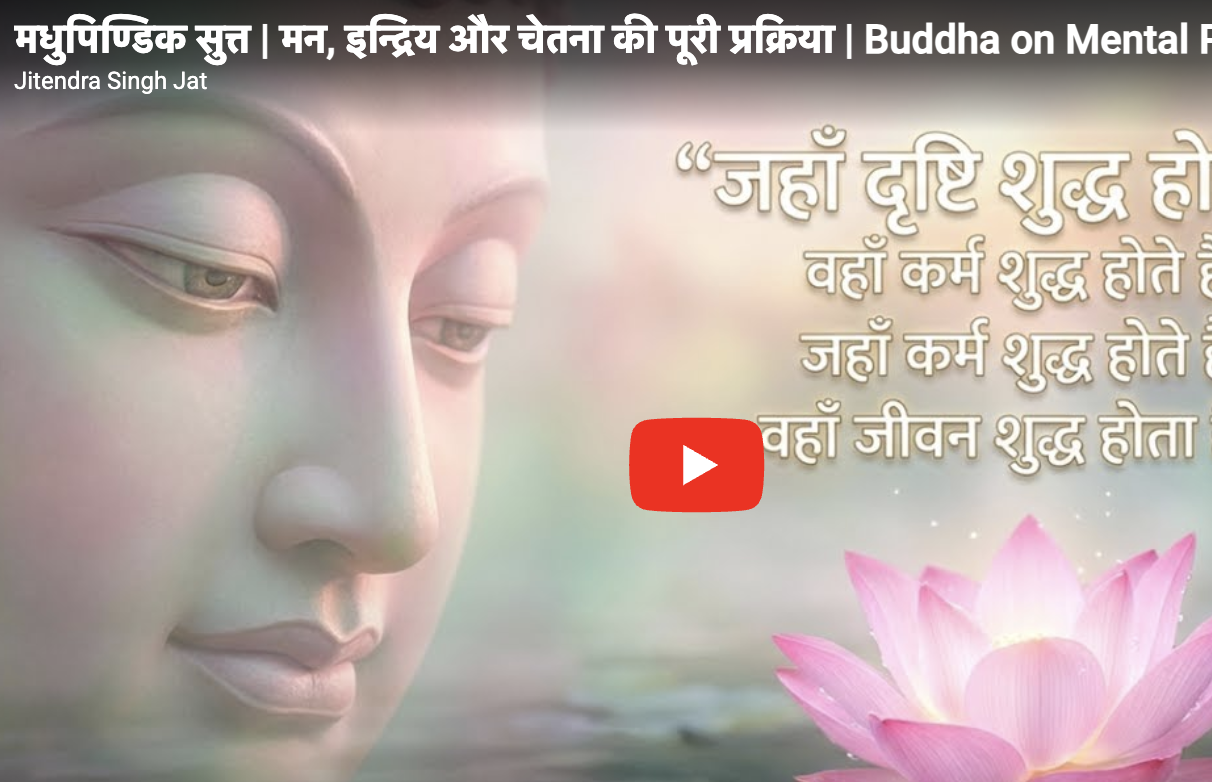







Why the Buddha Emphasized Vedanā (Sensations) Instead of Thoughts
Summary
- The Buddha identified vedanā (bodily sensations) as the crucial link between experience and reaction.
- Modern neuroscience also suggests that emotions are accompanied by physical changes before conscious thought fully develops.
- Vipassana meditation trains practitioners to observe sensations with equanimity instead of reacting automatically.
- The practice aims to reduce deeply conditioned habits of craving and aversion by changing how the mind responds.
One of the most distinctive aspects of the Buddha’s teaching is that he asked meditators to observe bodily sensations rather than becoming absorbed in thoughts. At first glance, this appears unusual. Most people believe their suffering comes from negative thinking, painful memories or external events. Yet according to the Buddha, the real turning point lies deeper—in the realm of vedanā, or sensations.
More than 2,500 years later, neuroscience is providing insights that make this ancient teaching increasingly relevant. While science and Buddhism use different frameworks, both suggest that much of human behaviour begins with automatic processes that occur before conscious reasoning takes full control.
Why Sensations Matter More Than Thoughts
Imagine someone criticises you.
Most people believe their anger arises because of the words spoken. However, if we observe carefully, another process unfolds almost instantly. The body may experience tightness in the chest, heat in the face, a faster heartbeat or tension in the stomach. These sensations appear almost immediately, often before we consciously decide how to respond.
Modern neuroscience explains that emotional events rapidly trigger physiological changes through interconnected brain and nervous system processes. The conscious mind becomes aware only after many of these bodily responses have already begun.
The Buddha described a remarkably similar sequence through direct observation:
Contact → Recognition → Vedanā (Sensation) → Reaction
According to this understanding, every experience first produces a sensation within the body. Pleasant sensations tend to generate craving, while unpleasant sensations produce aversion. Over thousands of repetitions throughout life, these reactions become deeply conditioned mental habits known as saṅkhāras.
This means we are often not reacting directly to people or situations—we are reacting to the sensations they generate inside us.
For example, an insult lasts only a few seconds. Yet the unpleasant sensations may linger for minutes or even hours. If the mind repeatedly reacts with anger or resentment, the emotional pattern strengthens.
The Buddha therefore shifted attention away from analysing endless thoughts and towards observing the sensations from which those thoughts often arise.
Vipassana: Breaking the Automatic Cycle
Vipassana meditation, preserved in the Theravāda Buddhist tradition and widely taught today through teachers such as S. N. Goenka, trains practitioners to observe bodily sensations objectively.
Rather than suppressing emotions or attempting to replace negative thoughts with positive ones, meditators simply observe sensations as they naturally arise and pass away.
A pleasant sensation is observed.
An unpleasant sensation is observed.
Neither is grasped nor resisted.
This practice develops equanimity, the ability to remain balanced regardless of changing internal experiences.
According to Vipassana, every time a practitioner observes sensations without reacting, the habitual cycle of craving and aversion becomes slightly weaker. Over months and years of consistent practice, deeply conditioned patterns gradually lose their intensity.
Modern psychology offers a complementary perspective. Research into mindfulness and emotional regulation suggests that cultivating non-judgmental awareness of present-moment experience can reduce impulsive reactions and improve emotional resilience. Although scientific studies do not directly confirm every traditional Buddhist explanation, they increasingly support the idea that awareness of bodily experience plays an important role in regulating emotions.
The Buddha’s emphasis on vedanā was therefore not an invitation to ignore thoughts, but to understand the deeper processes from which many thoughts and emotional reactions emerge.
In an age marked by stress, conflict and information overload, this insight remains surprisingly practical. We may not always control what others say or do, but we can learn to observe what happens within ourselves before reaction takes over.
Perhaps that is why the Buddha placed such importance on sensations. They represent the meeting point where unconscious habit can either continue—or where conscious awareness can begin the process of genuine inner transformation.

NewsHasghag operates a 24/7 news bureau that tracks the real-time, social media-driven stories from India and around the world, keeping you ahead of the day’s key talking points. Our digital-first approach transforms storytelling through the seamless integration of data, interactive charts, video, and audio into every narrative