



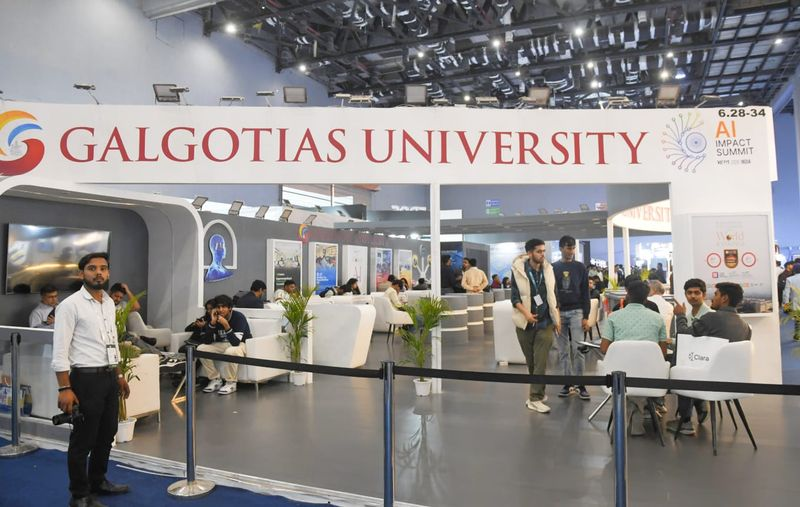
The controversy surrounding Galgotias University at the India AI Impact Summit
The controversy surrounding Galgotias University at the India AI Impact Summit 2026 has become a flashpoint for discussions on academic integrity and the ethics of technological representation in India. What began as a showcase of a ₹350-crore AI ecosystem at Bharat Mandapam ended in an unceremonious ousting of the university from the prestigious global event.
The “Orion” Debacle: From Innovation to Imitation
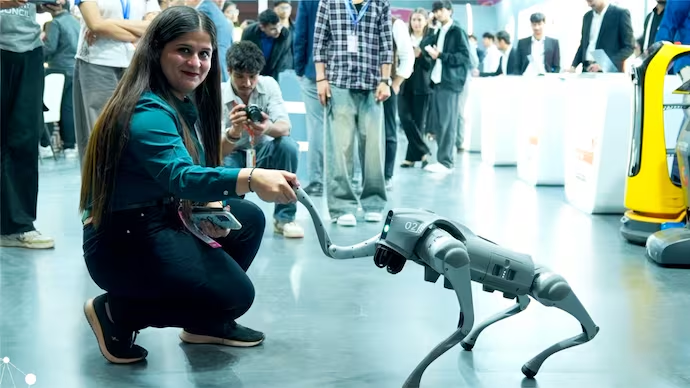
The center of the storm was a quadruped robotic dog, presented by the university under the name “Orion.” During the summit, viral video footage showed Professor Neha Singh describing the robot as an in-house development of the university’s Centre of Excellence. She claimed the robot was designed for campus surveillance and monitoring, projecting it as a breakthrough in indigenous AI research.
However, the global tech community was quick to identify “Orion” as a commercially available Unitree Go2, manufactured by the Chinese robotics firm Unitree Robotics. The robot, which retails for approximately $1,600 to $2,800 (roughly ₹1.3–2.3 lakh), was clearly recognizable despite the university’s branding.
International Backlash and “Bharat Mandapam” Exit
The incident drew sharp criticism from international media and social media users, who accused the institution of “rebranding” off-the-shelf Chinese technology as original Indian innovation. The embarrassment reached a peak when Chinese social media platforms began highlighting the “sham,” leading to concerns about the credibility of Indian institutions on the global stage.
Reacting to the mounting controversy, the organizers of the AI Impact Summit—reportedly under government direction—instructed Galgotias University to vacate its stall immediately. By the third day of the summit, the university’s pavilion stood empty, and “Orion” was nowhere to be seen.
Internal Finger-Pointing and Damage Control
In an attempt to manage the fallout, Galgotias University issued a formal clarification, stating they never officially claimed to have manufactured the robot. They argued the machine was acquired as a “classroom in motion” to provide students with hands-on exposure to global technologies.
The university administration appeared to distance itself from the initial claims, essentially shifting the burden of the “misinterpretation” onto Professor Neha Singh. In later interviews, Professor Singh, a faculty member from the School of Management (not AI), admitted her remarks might not have been “clearly articulated,” stating that the “euphoria and rush” of the event led to a misunderstanding. She emphasized that the intention was never to claim ownership, yet the damage to the university’s reputation remained significant.
The Galgotias incident serves as a cautionary tale for educational institutions participating in high-stakes global summits. While sourcing international technology for research is standard practice, passing it off as “indigenous innovation” undermines the genuine hard work of Indian researchers and damages national prestige.
Also Read:https://newshashtag.com/can-bill-gates-still-be-trusted-on-the-ai-stage/

NewsHasghag operates a 24/7 news bureau that tracks the real-time, social media-driven stories from India and around the world, keeping you ahead of the day’s key talking points. Our digital-first approach transforms storytelling through the seamless integration of data, interactive charts, video, and audio into every narrative