





Bihar NDA Job Promise: One Crore Jobs or Election Illusion?
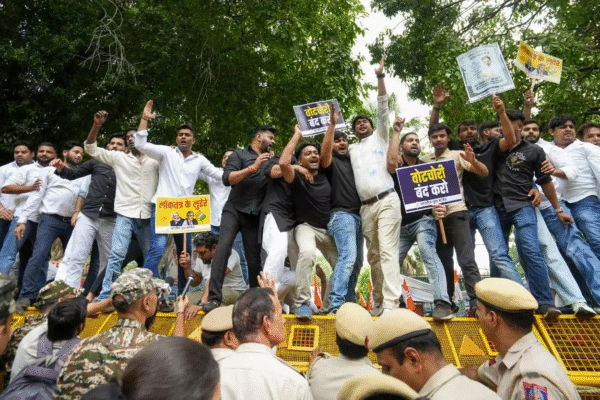
The Bihar NDA job promise has sparked both excitement and doubt. The alliance has pledged one crore government jobs, ₹10 lakh support for EBCs, free ration, and free healthcare. These promises sound transformative, but voters are now asking a crucial question — can they actually be delivered, or are they just election-season slogans?
Bihar enters election season once again, and this time the promises sound louder than ever. On paper, the blueprint looks ambitious and transformative. Yet, as Bihar voters know from experience, grand political announcements often collide with harsh administrative realities. Therefore, the question becomes unavoidable: Are these promises a path to prosperity or another election-season illusion?
A Mountain of Promises: Can Bihar’s Budget Carry It?
At first glance, the offer of one crore government jobs sounds historic. In a state battling unemployment and migration for decades, the employment pitch taps directly into public pain. Additionally, the pledge of financial aid to Economically Backward Classes (EBCs) may provide crucial support to some of the poorest families.
However, Bihar’s fiscal reality raises immediate concerns. The state’s current economic capacity and administrative structure do not align with such rapid expansion. Bihar’s government workforce today is only a fraction of what is being promised, and creating one crore new government jobs would require deep structural reforms, fresh budget allocations, and a clear recruitment timeline — none of which has been disclosed.
Moreover, earlier election cycles witnessed ambitious commitments that did not fully translate on ground. As a result, despite the emotional appeal, skepticism is growing, especially among youth who seek clear paths to employment rather than repeated promises.
What Nitish Kumar Has Delivered in the Past
Nitish Kumar’s record complicates the debate. His early tenure earned him praise for improving law and order, enhancing road connectivity, and expanding school enrolment through initiatives like bicycle schemes for girls. Bihar saw a visible shift in safety, governance, and social indicators during his initial years, marking a break from the ‘jungle raj’ narrative that defined the 1990s.
However, the later years saw slowing momentum. Industrial investment remained limited, and despite growth in education access, jobs did not keep pace. Migration continued, and youth frustration deepened as promises of employment and industry often remained on paper. Nitish’s shifting political alliances also created instability, affecting public confidence. Therefore, while his governance legacy has notable achievements, gaps in long-term economic planning and job creation remain central to voter anxieties today.
Freebies vs. Development — What Bihar Actually Needs
The NDA’s manifesto also highlights welfare promises: free ration, free electricity up to 125 units, and free healthcare up to ₹5 lakh. These measures are appealing, particularly for lower-income families who continue to battle economic stress. Yet, a rising segment of Bihar’s young electorate is asking whether short-term relief can substitute for long-term progress.
Bihar needs industry, skills development, and rural economic strengthening. Welfare may ease survival, but only development can ensure dignity and livelihood. Political analysts argue that electoral manifestos should explain howemployment will be created, not just promise it. Without clear financial planning and administrative roadmaps, voters worry these assurances may fade after polling day.
Bihar stands at a crossroads. The NDA’s promises, if executed with sincerity and clarity, could change the state’s future. But if they remain slogans, they will deepen public disillusionment and compel another generation to leave home in search of opportunity. Ultimately, voters must weigh aspiration against memory — and decide whether to believe in a bold vision or demand proof before trust.
Gyaneshwar brings more than three decades of distinguished journalistic experience to the team. He has contributed significantly to both print and electronic media and directed several documentary films. For over 35 years, he has held key editorial roles in newspapers and TV channels, including The Pioneer and JAIN TV. Known for his balanced perspective and in-depth analysis, he brings leadership and expertise, and ensures accuracy, relevance, and clarity in every story.