




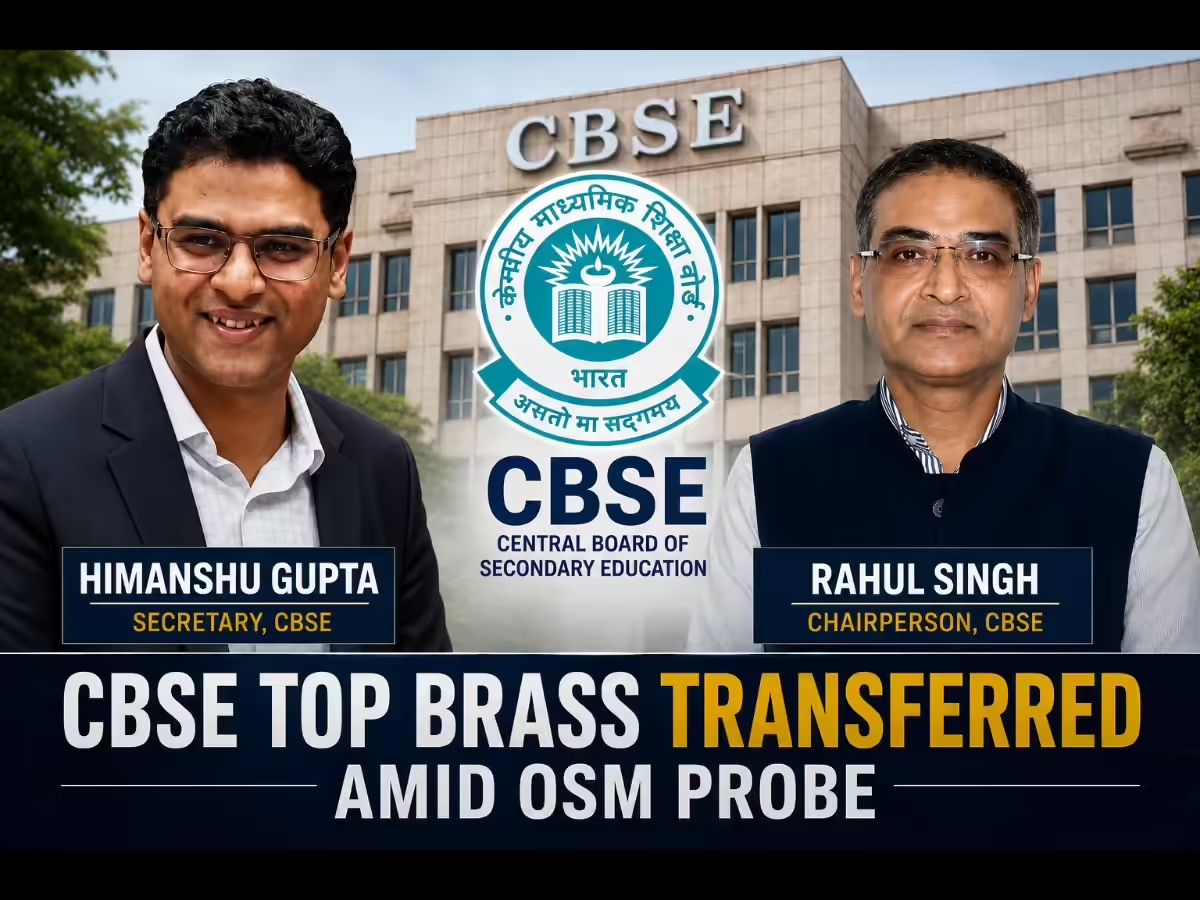
CBSE Chairman, Secretary Replaced Amid OSM Row; Centre Orders Probe into Portal Procurement
The Union Government has undertaken a major administrative reshuffle at the Central Board of Secondary Education (CBSE), replacing both its Chairman and Secretary in the wake of the ongoing controversy surrounding the Online Scanning and Marking (OSM) system. The move comes amid mounting criticism over discrepancies in CBSE Class 12 answer-sheet evaluation and concerns about the procurement of services linked to the board’s digital assessment infrastructure.
The Department of Personnel and Training (DoPT) has appointed Lokhande Prashant Sitaram as the new CBSE Chairman, replacing Rahul Singh, who has been shifted to the Ministry of Agriculture and Farmers Welfare. Simultaneously, the Centre has also initiated an inquiry into the procurement process associated with CBSE’s OSM portal, signaling a serious review of the board’s recent technological transition.
The decision marks one of the most significant interventions in CBSE’s administration in recent years and reflects the government’s determination to restore confidence in the country’s largest school examination board.
OSM Controversy Raises Questions on Digital Transition
The controversy emerged after several students and parents alleged discrepancies between scanned answer sheets and marks awarded in the Class 12 board examinations. Complaints ranged from missing pages and improper scanning to concerns that evaluators may not have had access to complete answer scripts during the assessment process.
The OSM system was introduced as part of CBSE’s efforts to modernize evaluation, improve efficiency, and reduce logistical challenges associated with transporting physical answer sheets across the country. While digitization was expected to enhance transparency and speed, the recent controversy has highlighted the risks of implementing large-scale technological reforms without adequate testing, oversight, and quality-control mechanisms.
Education experts argue that digital transformation in examination systems requires robust safeguards because even minor technical errors can affect thousands of students. In high-stakes examinations such as Class 12 board exams, any perceived lapse in evaluation can undermine public trust and trigger widespread anxiety among students and families.
Critics have also pointed out that the problems indicate deeper governance concerns. If scanning, data handling, or quality checks were not sufficiently monitored, the issue extends beyond technology and enters the realm of administrative accountability.
The fact that many complaints surfaced only after students sought access to answer-sheet copies has further intensified demands for greater transparency in the evaluation process.
Administrative Accountability and Institutional Credibility
The appointment of a new CBSE Chairman and the decision to establish a one-member inquiry committee suggest that the government views the matter as more than a routine operational glitch. By ordering a probe into the procurement of services for the OSM portal, the Centre appears keen to examine whether due diligence, financial prudence, and procedural norms were followed during the implementation of the system.
Such inquiries are particularly significant because public examination systems depend heavily on institutional credibility. Parents, students, universities, and employers rely on CBSE results as an accurate reflection of academic performance. Any controversy that casts doubt on the integrity of evaluation processes can have far-reaching consequences.
The administrative changes also send a message that accountability will accompany digital reforms. Across sectors, governments are increasingly adopting technology-driven solutions, but successful implementation depends not only on software and infrastructure but also on governance, monitoring, and responsiveness to stakeholder concerns.
For CBSE, the challenge now is twofold: addressing the immediate concerns of affected students and rebuilding confidence in its examination ecosystem. The inquiry committee’s findings may provide important insights into whether procedural lapses occurred and what corrective measures are needed.
As India continues its push toward digital governance in education, the CBSE episode serves as a reminder that technology can strengthen institutions only when supported by transparency, accountability, and rigorous oversight. The coming months will determine whether the board can turn this controversy into an opportunity for reform and restore trust among millions of students who depend on its examinations every year.

NewsHasghag operates a 24/7 news bureau that tracks the real-time, social media-driven stories from India and around the world, keeping you ahead of the day’s key talking points. Our digital-first approach transforms storytelling through the seamless integration of data, interactive charts, video, and audio into every narrative