



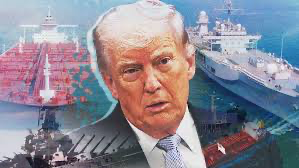
How the US Navy Could Blockade Iran’s Ports and What It Means for Iran and India
The United States’ decision to impose a naval blockade on Iran is not merely a military maneuver—it is a calculated attempt to exert economic pressure through control of one of the world’s most critical maritime routes. What may appear as a regional escalation is, in reality, a move with far-reaching consequences for global trade, energy markets, and countries like India that depend heavily on imported fuel.
At the centre of this strategy lies the Strait of Hormuz, a narrow but vital passage through which nearly one-fifth of the world’s oil supply flows. Rather than enforcing a complete shutdown, the US Navy is likely implementing a selective blockade—targeting vessels linked specifically to Iranian ports while allowing general international shipping to continue under strict monitoring. This approach enables Washington to pressure Tehran economically without triggering a total collapse of global trade.
Strategic Enforcement at Sea: Pressure Without Full-Scale War
In operational terms, such a blockade relies on a combination of naval deployment, surveillance, and real-time intelligence. US warships, supported by satellites and tracking systems, monitor ship movements across the Gulf. Vessels suspected of carrying Iranian oil or heading to Iranian ports can be intercepted, inspected, or redirected. This form of maritime control does not require constant confrontation; its effectiveness lies in deterrence. The mere presence of a strong naval force raises insurance costs, discourages shipping companies, and gradually isolates Iran from global trade networks.
For Iran, the economic implications are severe. Oil exports form the backbone of its economy, and any sustained disruption directly translates into lost revenue. Even a partial blockade can cost billions of dollars over time, weakening the country’s foreign exchange reserves and limiting its ability to finance both domestic programs and strategic operations. Beyond oil, restricted access to ports also affects imports, further tightening economic pressure.
Global Ripple Effects: Why India Cannot Remain Unaffected
However, the impact of this blockade does not stop at Iran’s borders. The interconnected nature of global energy markets means that any disruption in the Strait of Hormuz quickly reverberates worldwide. Oil prices have already shown upward pressure, reflecting fears of reduced supply and uncertainty in shipping routes. This volatility is not just a market reaction—it has real consequences for economies dependent on energy imports.
For India, the implications are particularly significant. As one of the world’s largest energy importers, India relies heavily on crude oil shipments passing through this corridor. Any disruption—whether due to physical restrictions or rising insurance and freight costs—inevitably leads to higher fuel prices domestically, fuelling inflation and increasing the cost of transportation and essential goods.
The effects extend further. India’s dependence on the Gulf region is not limited to crude oil; it also includes liquefied petroleum gas (LPG) and fertilisers. A prolonged disruption could strain supply chains, impacting agriculture and food prices. In this sense, a naval blockade thousands of kilometres away can quietly influence everyday life—from household budgets to farming costs.
A High-Stakes Economic Strategy
What makes the situation even more complex is the strategic uncertainty surrounding enforcement. While the US Navy possesses superior technological and operational capabilities, Iran holds a geographical advantage along the Strait. Its ability to deploy missiles, drones, or fast naval units introduces the risk of escalation, where even a minor confrontation could disrupt shipping lanes further.
The US naval blockade of Iran represents a modern form of conflict where control over trade routes becomes as powerful as control over territory. For Iran, it threatens economic stability; for India and other nations, it introduces rising costs and uncertainty.
The critical question now is not just whether the blockade will achieve its strategic objective, but whether the world can absorb its economic shock without tipping into a broader crisis.

Prabha Gupta is a veteran journalist and civic thinker dedicated to the constitutional ideals of dignity and institutional ethics. With over thirty years of experience in public communication, her work serves as a bridge between India’s civil society and its democratic institutions. She is a prominent voice on the evolution of Indian citizenship, advocating for a national discourse rooted in integrity and the empowerment of the common citizen