


ASEAN Summit India: PM Modi Calls ASEAN Key to Act East Policy and Culture
PM Modi Highlights ASEAN’s Role in India’s Act East Policy
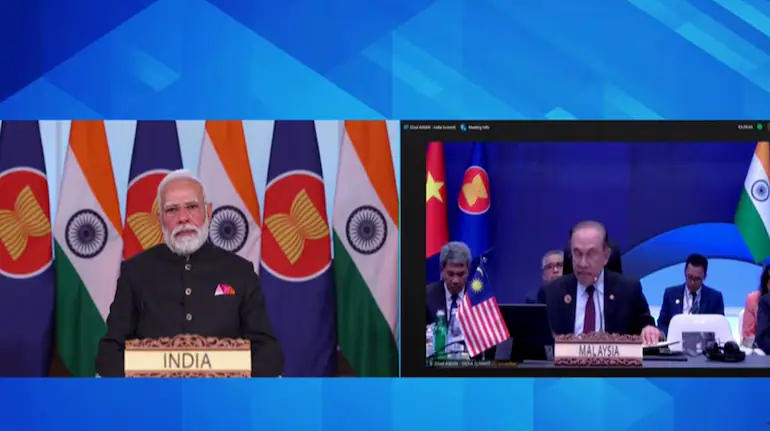
NEW DELHI: Prime Minister Narendra Modi on Sunday virtually addressed the 47th ASEAN Summit, calling the ASEAN Summit India partnership the “main pillar” of India’s Act East Policy. He emphasized that India and ASEAN are not just trade allies but cultural partners with shared values and heritage.
Modi underlined the importance of strengthening ties between India and Southeast Asia in areas such as commerce, digital innovation, and cultural exchange. He noted that mutual cooperation can help ensure stability and prosperity in the Indo-Pacific region.
Transitioning to global economic concerns, Modi’s remarks came at a time when the world continues to deal with the impact of tariff impositions by former U.S. President Donald Trump, which disrupted international trade balances. He asserted that open markets and regional collaboration remain essential to sustaining global economic growth.
He addressed the summit emphasising that the relationship between India and ASEAN goes beyond economics and trade. Calling ASEAN a core pillar of India’s Act East Policy, Modi said the partnership reflects a shared vision for peace, progress, and prosperity in the Indo-Pacific region.
He stated, “ASEAN and India are not just trading partners; we are cultural partners bound by history and values. Together, we can build a future defined by cooperation and confidence.”
Modi’s remarks reinforced India’s commitment to expanding ties in digital connectivity, maritime security, renewable energy, and education. He highlighted that ASEAN nations are central to India’s Indo-Pacific strategy, ensuring stability and growth through collaboration.
A Brief Look at ASEAN and India’s Deepening Engagement
The Association of Southeast Asian Nations (ASEAN) was established in 1967 with five founding members — Indonesia, Malaysia, the Philippines, Singapore, and Thailand. Over the years, it expanded to include ten member states, becoming one of the world’s most influential regional organizations.
India’s association with ASEAN began in 1992 as a “sectoral dialogue partner,” later becoming a full dialogue partner in 1996. The relationship reached a new height in 2012, when both sides commemorated 20 years of partnership and adopted a strategic partnership agreement.
Under the Act East Policy, launched in 2014, India has strengthened ties with ASEAN in trade, defense, technology, and culture. This policy replaced the older “Look East Policy,” giving greater focus to action-oriented cooperation. Today, ASEAN represents India’s fourth-largest trading partner, with bilateral trade crossing $110 billion annually.
Cultural Links and a Shared Vision for the Future
PM Modi underlined that India and ASEAN’s relationship rests on a strong foundation of shared culture, language, and faith. Ancient trade routes, maritime exchanges, and the spread of Buddhism and Hinduism connected Southeast Asia and India long before modern diplomacy.
Transitioning to regional issues, Modi urged leaders to maintain peace, freedom of navigation, and a rules-based orderin the Indo-Pacific. He stressed that cooperation in climate change, renewable energy, and digital transformation can unlock new opportunities for sustainable development.
Leaders at the summit agreed that the ASEAN–India partnership has matured from a transactional to a transformationalrelationship. The focus now lies on connectivity, culture, and collaboration — values that define both regions’ identities and aspirations.
The 47th ASEAN Summit in Laos marked another step in India’s growing engagement with Southeast Asia, reinforcing Modi’s vision of a region where nations progress together, respecting diversity while sharing prosperity.
Gyaneshwar brings more than three decades of distinguished journalistic experience to the team. He has contributed significantly to both print and electronic media and directed several documentary films. For over 35 years, he has held key editorial roles in newspapers and TV channels, including The Pioneer and JAIN TV. Known for his balanced perspective and in-depth analysis, he brings leadership and expertise, and ensures accuracy, relevance, and clarity in every story.