

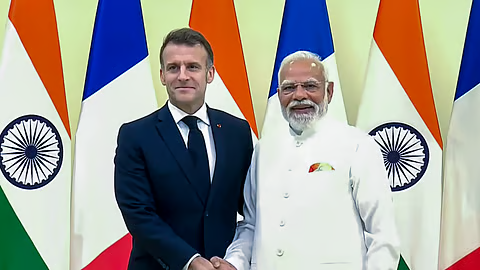
Fresh off his bilateral and multilateral engagements at the G7 Summit, Prime Minister Narendra Modi landed in Paris to chart a meticulous blueprint for India’s next industrial chapter. Meeting with an elite cohort of French CEOs, the dialogue bypassed generic diplomatic pleasantries, shifting instead straight into core executive actions. The strategic huddle hammered out concrete expansion roadmaps across five definitive structural pillars: maritime shipping, modern transit, heavy infrastructure, and frontier artificial intelligence.
By pitching India not just as a consumer market, but as an indispensable co-manufacturing hub, the discussions highlighted New Delhi’s broader geopolitical ambitions: insulating global supply chains and anchoring deep-tech innovation on Indian soil.
The New Indian Express
From Deep-Sea Ports to Bullet Trains: Re-engineering India’s Physical Backbone
A critical takeaway from the roundtable is the focus on upgrading India’s physical logistical networks. In the maritime sphere, Modi’s detailed discussion with Rodolphe Saadé, Chairman and CEO of shipping giant CMA CGM, yielded clear commitments toward advanced domestic infrastructure. The French shipping titan revealed plans to venture into specialized container manufacturing, deep-sea port optimization, and ship-recycling programs natively within India. Moving container manufacturing directly to Indian coastlines marks a massive shift toward establishing localized, resilient end-to-end supply chains.
Concurrently, heavy transportation and sustainable engineering took center stage. In a focused meeting with Martin Sion, CEO of Alstom, the roadmap centered entirely on mobility and heavy rail modernization. Alstom has already become a staple in India’s urban metro frameworks, but the next phase promises deeper investments aimed at expanding local manufacturing plants. This is expected to directly stimulate regional job creation while driving down internal freight costs.
YouTube+ 2
To structurally house these grand mobility networks, the Prime Minister roped in Benoit Bazin, Chairman and CEO of Saint-Gobain. Their discussions anchored heavily on green, sustainable construction materials, matching India’s massive urban sprawl with low-carbon engineering practices. By securing expansion commitments from Saint-Gobain, New Delhi is deliberately leveraging French material science to fulfill its complex climate-resilient infrastructure targets.
Democratizing the Digital Frontier: An “All-Inclusive” Approach to AI
Beyond physical concrete and iron rails, the most futuristic and strategically vital segment of the Paris discussions rested squarely on digital sovereignty. Prime Minister Modi sat down with Arthur Mensch, the co-founder and CEO of Mistral AI—Europe’s premier open-weights pioneer currently challenging Silicon Valley’s monopoly. The conversation moved past hype, focusing directly on integrating sovereign Indian language datasets and localized model architectures.
Mensch expressed strong alignment with collaborating inside India’s rapidly expanding tech ecosystem, noting that the country’s scale offers a unique playground for deploying frontier AI models. For New Delhi, partnering with a flag-bearer of open AI architectures fits perfectly into its domestic policy. During his subsequent tech address in Paris, Modi cleanly encapsulated India’s digital philosophy, stating that tech can only lead to progress if democratized, defining India’s vision for the technology as “All-Inclusive” AI. By partnering directly with European tech giants, India is consciously creating a multipolar tech landscape that avoids reliance on single-nation cloud providers.
Ultimately, this high-powered economic huddle demonstrates that the India-France relationship has graduated from simple defense acquisition deals into a deep industrial and computational alliance. For the global corporate chiefs sitting across from the Prime Minister, the consensus was uniform: India’s future isn’t a distant milestone—it is actively unfolding right now.

Prabha Gupta is a veteran journalist and civic thinker dedicated to the constitutional ideals of dignity and institutional ethics. With over thirty years of experience in public communication, her work serves as a bridge between India’s civil society and its democratic institutions. She is a prominent voice on the evolution of Indian citizenship, advocating for a national discourse rooted in integrity and the empowerment of the common citizen