





Cabinet Clears ₹1.28 Lakh Crore Semiconductor Mission: Can India’s Biggest Chip Push Make the Country a Global Electronics Powerhouse?
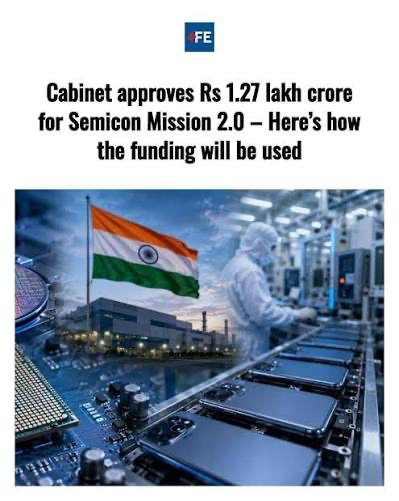
New Delhi: In one of the most ambitious industrial policy decisions in recent years, the Union Cabinet has approved a fresh ₹1.28 lakh crore semiconductor mission, significantly expanding India’s efforts to build a domestic chip manufacturing ecosystem. The move underscores the Narendra Modi government’s determination to reduce dependence on imported semiconductors, attract global technology giants and position India as a trusted alternative in an increasingly fragmented global supply chain.
The decision comes at a time when semiconductors have become the backbone of the global economy, powering everything from smartphones and automobiles to defence systems, artificial intelligence, data centres and consumer electronics.
For India, the mission is about far more than manufacturing chips—it is about economic security, technological sovereignty and employment generation.
Why Semiconductors Matter
Often described as the “new oil” of the digital economy, semiconductor chips are critical components in virtually every modern electronic device.
The COVID-19 pandemic exposed the vulnerability of global supply chains when chip shortages disrupted automobile production, consumer electronics manufacturing and industrial output worldwide.
The geopolitical rivalry between the United States and China has further accelerated efforts by countries to diversify semiconductor manufacturing.
India sees this as an opportunity to emerge as a reliable manufacturing destination.
Building on Earlier Initiatives
The newly approved package builds upon the government’s earlier Semiconductor Mission launched in 2021.
Over the past few years, India has announced incentives for semiconductor fabrication plants (fabs), chip assembly and testing facilities (ATMP/OSAT units), compound semiconductors and semiconductor design.
Several global and domestic companies have already announced investments in Gujarat, Assam and other states to establish semiconductor-related facilities.
The latest funding aims to accelerate these investments while encouraging additional private sector participation.
More Than Just Manufacturing
Industry experts believe the new mission goes beyond setting up fabrication plants.
It seeks to develop an integrated semiconductor ecosystem that includes:
- wafer fabrication;
- chip packaging and testing;
- semiconductor equipment manufacturing;
- research and development;
- chip design;
- skilled workforce development;
- supply-chain infrastructure.
Such an ecosystem would reduce India’s dependence on imports while strengthening its position in global electronics manufacturing.
Employment Potential
One of the most significant aspects of the mission is its potential to generate employment.
Semiconductor manufacturing is highly technology-intensive, but it also creates thousands of direct and indirect jobs across engineering, research, construction, logistics, equipment manufacturing and ancillary industries.
The initiative could particularly benefit India’s growing pool of engineers graduating from IITs, NITs and other technical institutions.
Industry estimates suggest that every major semiconductor manufacturing project generates employment across multiple layers of the value chain, from highly skilled chip designers to technicians, construction workers and service providers.
This assumes greater importance as India seeks to create quality employment for its young workforce.
While official data show that India’s overall unemployment rate has declined to 3.1 percent, youth unemployment remains significantly higher, highlighting the need for high-value manufacturing jobs capable of absorbing skilled graduates.
Reducing Import Dependence
India currently imports a substantial portion of the semiconductors used in electronics manufacturing.
As the country’s electronics market continues to expand rapidly, semiconductor imports are expected to rise sharply unless domestic manufacturing capacity is established.
The new mission aims to improve supply-chain resilience by encouraging local production while reducing exposure to global disruptions.
Greater domestic production could also strengthen India’s export competitiveness over the long term.
Global Competition Remains Intense
Despite the ambitious investment, India faces formidable competition.
Taiwan, South Korea and the United States dominate advanced semiconductor manufacturing, while China continues investing heavily despite export restrictions imposed by Western countries.
Building a globally competitive semiconductor industry requires sustained investment, uninterrupted policy support, access to advanced technology, abundant electricity, ultra-pure water, sophisticated logistics and a highly skilled workforce.
Industry experts caution that semiconductor manufacturing cannot be developed overnight.
Countries that dominate the industry today have spent decades building technological capabilities.
Challenges Ahead
While government incentives are important, experts argue that India’s long-term success will depend on several factors:
- attracting leading global chip manufacturers;
- ensuring policy stability;
- developing specialised engineering talent;
- strengthening research institutions;
- improving infrastructure;
- protecting intellectual property;
- integrating Indian firms into global semiconductor supply chains.
Without these complementary reforms, financial incentives alone may not be sufficient to establish India as a global semiconductor hub.
Strategic Significance
Beyond economics, the semiconductor mission carries important geopolitical implications.
As multinational companies diversify production away from concentrated manufacturing bases, India hopes to position itself as a trusted partner in global supply chains.
The initiative also complements broader programmes such as Make in India, Digital India, the Production Linked Incentive (PLI) scheme and India’s ambition to become a major electronics manufacturing centre.
If successful, the semiconductor ecosystem could strengthen sectors ranging from electric vehicles and telecommunications to artificial intelligence, defence production and consumer electronics.
Looking Ahead
The Cabinet’s approval of the ₹1.28 lakh crore semiconductor mission marks one of India’s boldest industrial investments in recent decades. It reflects a strategic recognition that semiconductors are central to future economic growth, national security and technological leadership.
However, the mission’s success will not be measured solely by the number of factories established or the size of government incentives. Its real test will be whether India can build a globally competitive semiconductor ecosystem that generates innovation, attracts sustained investment and creates high-quality employment.
For a country aspiring to become a developed economy by 2047, success in semiconductors could prove to be one of the defining pillars of India’s next phase of industrial transformation.

NewsHasghag operates a 24/7 news bureau that tracks the real-time, social media-driven stories from India and around the world, keeping you ahead of the day’s key talking points. Our digital-first approach transforms storytelling through the seamless integration of data, interactive charts, video, and audio into every narrative