




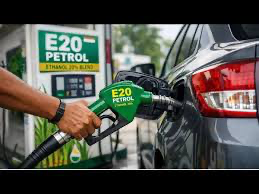
From Fuel Tanks to Public Trust: What the E20 Petrol Debate Says About India’s Green Transition
For most Indians, petrol is simply something they refill every week without giving much thought to what goes into it. But the introduction of E20 petrol—a blend of 20% ethanol and 80% petrol—has unexpectedly transformed a routine fuel stop into a national conversation about technology, economics, environmental policy and consumer rights.
The recent protests against E20 petrol may have been small in scale, but they reflect a much larger challenge confronting governments worldwide: how to convince people that a policy designed for the country’s long-term benefit is also in their immediate interest.
The debate is no longer just about ethanol. It is about trust.
A Policy Born Out of Necessity
India’s push towards ethanol blending did not begin as an environmental initiative alone. It was primarily driven by energy security.
India imports nearly 85% of its crude oil requirement, making the country highly vulnerable to geopolitical conflicts, supply disruptions and volatile international oil prices. Every global crisis—from the Russia-Ukraine war to tensions in the Middle East—immediately affects India’s fuel import bill.
Ethanol offers an alternative.
Produced domestically from sugarcane, maize and other agricultural feedstocks, ethanol helps reduce dependence on imported crude oil while supporting Indian farmers. Over the past decade, the government has steadily increased ethanol blending from single digits to 20%, achieving its target years ahead of schedule.
From a policy perspective, the programme has largely been a success. It has reduced foreign exchange outflow, strengthened energy security and created an additional market for agricultural produce.
Yet successful policy implementation is measured not only by statistics but also by public acceptance.
Why Consumers Feel Uneasy
The concerns surrounding E20 petrol are rooted less in ideology and more in everyday experience.
Motorists worry about fuel efficiency because ethanol contains less energy than conventional petrol. Even a small reduction in mileage matters to daily commuters facing already high fuel costs.
Owners of older vehicles have another concern: compatibility.
Although automobile manufacturers have gradually introduced E20-compatible engines, millions of vehicles currently on Indian roads were designed before E20 became the standard. Many owners remain uncertain whether prolonged use could affect engine components, maintenance costs or resale value.
Whether these concerns are scientifically justified in every case is almost secondary.
In public policy, perception often shapes behaviour as much as technical evidence.
The Communication Gap
Perhaps the biggest weakness in India’s E20 rollout has not been the technology but the communication.
Government agencies have repeatedly highlighted the environmental and economic advantages of ethanol blending. Scientists have explained that compatible vehicles can safely operate on E20.
However, much of this information has remained confined to official statements, technical reports and automobile advisories.
Consumers, meanwhile, receive much of their information from social media, WhatsApp forwards and personal experiences shared online. A single viral video claiming reduced mileage often reaches more people than a detailed government clarification.
This gap between scientific communication and public understanding has allowed uncertainty to grow.
The Global Perspective
India is not the first country to encounter resistance while transitioning to cleaner fuels.
Brazil has used ethanol-blended fuels for decades, supported by a strong ecosystem of flex-fuel vehicles. The United States has widely adopted E10 and E15 blends, while several European nations have expanded the use of biofuels as part of their climate commitments.
The common lesson from these countries is clear: successful energy transitions require preparation beyond policy announcements.
Vehicle manufacturers, fuel retailers, regulators and consumers must move together.
When one stakeholder moves faster than the others, public confidence suffers.
The Bigger Picture
The E20 debate also reflects a broader reality about climate action.
Governments around the world are asking citizens to adopt electric vehicles, rooftop solar panels, cleaner fuels and energy-efficient appliances. These transitions are essential for reducing carbon emissions and achieving climate goals.
However, people tend to support environmental policies only when they are convinced that the benefits outweigh the personal costs.
Consumers expect transparency, clear information and genuine choice—not merely assurances that the transition is necessary.
The Road Ahead
India is unlikely to reverse its ethanol blending programme. Nor should it.
Reducing crude oil dependence, supporting farmers and lowering emissions remain vital national objectives.
But the next phase of the programme should focus less on increasing blending percentages and more on strengthening public confidence.
Greater transparency about vehicle compatibility, wider public awareness campaigns, clearer labelling at fuel stations and continued investment in flex-fuel technology could address many of the concerns currently surrounding E20.
Ultimately, the controversy over E20 petrol is not a story about fuel.
It is a story about how governments manage change in an era when every policy is instantly scrutinized by millions of informed—and often skeptical—citizens.
India’s transition to cleaner energy will ultimately depend not only on scientific innovation or ambitious policy targets, but also on something far more difficult to achieve: public trust.