


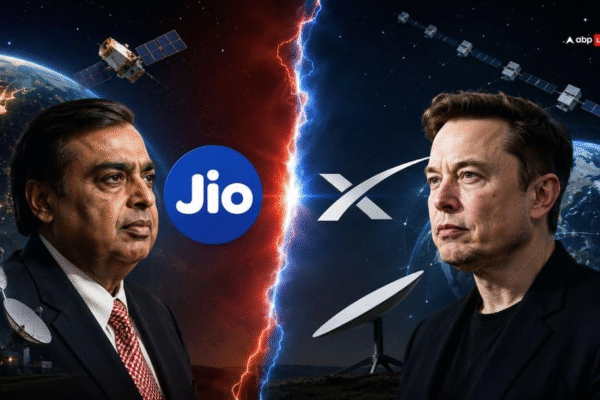


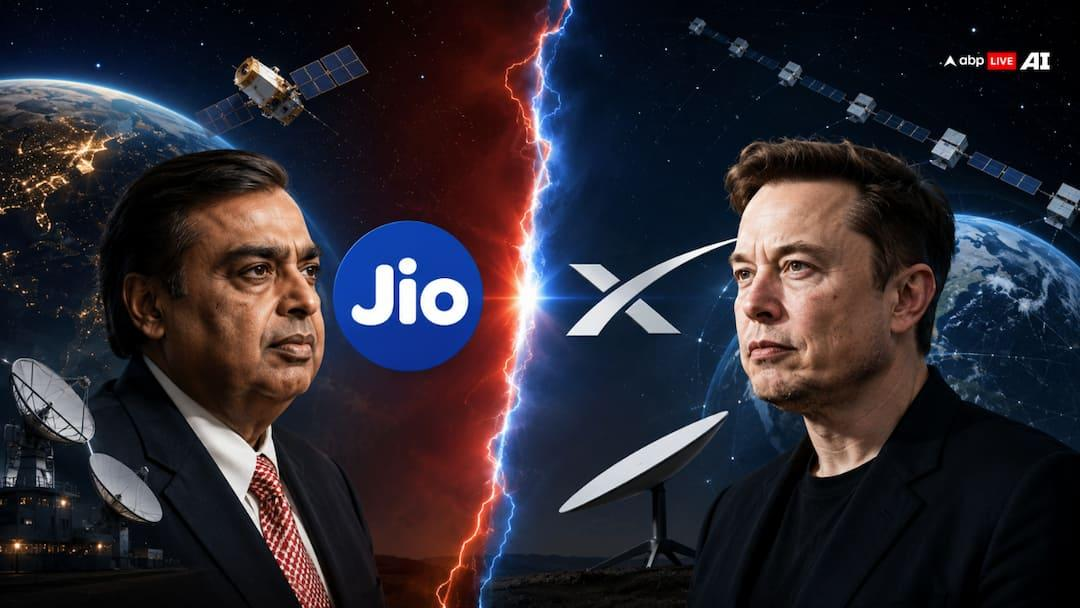
Jio vs Starlink: Can Mukesh Ambani Challenge Elon Musk in the Satellite Internet Race?
India’s telecommunications battle is preparing to move from mobile towers to outer space. Reliance Jio is considering an ambitious low-Earth-orbit (LEO) satellite network that could place it in direct competition with Elon Musk’s Starlink, opening a new chapter in the contest to connect remote regions and underserved communities.
The proposed venture represents more than a technological expansion for Jio. It reflects India’s growing interest in developing domestic space infrastructure, reducing dependence on foreign satellite operators and extending internet access to locations where conventional broadband networks remain difficult to establish.
According to reports, Jio is planning a constellation of approximately 1,600 satellites, with a test flight targeted for September 2027 and broader deployment expected to begin in 2028. The company is also working towards building the necessary ground infrastructure to support satellite connectivity.
Why is Jio looking towards space?
Undersea cables, optical fibre and mobile towers have transformed internet access across India. However, geographical barriers continue to make connectivity expensive and challenging in mountainous regions, remote villages, border areas and isolated communities.
Satellite internet offers an alternative by transmitting data between satellites, ground stations and user terminals without requiring conventional broadband infrastructure at every location.
For Jio, which built its position in India’s telecommunications market through affordable mobile data, satellite connectivity could provide another avenue for expansion. It could serve households, businesses, government agencies and institutions located beyond the practical reach of terrestrial networks.
Jio Platforms has said it is evaluating an indigenous satellite constellation and associated ground infrastructure while also exploring partnerships with international satellite operators to accelerate service availability. The company has acknowledged that satellite connectivity could become a competitive risk for its existing broadband businesses if the technology becomes more affordable and widely adopted.
Starlink faces a powerful domestic rival
Starlink, operated by SpaceX, has established a substantial presence in the global satellite internet market. Its network of low-Earth-orbit satellites is designed to provide broadband connectivity with lower latency than traditional geostationary satellite systems.
Musk has pledged to make Starlink affordable in India, intensifying competition with Jio. However, he has not announced definitive Indian consumer prices, and the economics of satellite broadband remain a significant challenge in a country where mobile data is exceptionally inexpensive.
Jio’s potential advantage lies in its domestic market knowledge, telecommunications infrastructure, distribution network and experience in serving millions of price-conscious customers.
Nevertheless, building and maintaining a satellite constellation requires enormous capital investment, advanced engineering and sustained operational expertise. Jio will also need to demonstrate that its proposed network can deliver reliable service at commercially competitive prices.
Can satellite internet transform rural India?
The technology could have significant implications for digital inclusion.
Remote schools could gain access to online educational resources, healthcare facilities could improve telemedicine services, and businesses in poorly connected areas could participate more effectively in the digital economy.
Satellite connectivity could also support disaster response when terrestrial communications infrastructure is damaged.
However, satellite internet is not a complete replacement for fibre broadband or mobile networks. Equipment costs, subscription charges, weather-related disruptions and available network capacity will influence its usefulness.
Jio itself has cautioned that satellite broadband may struggle to compete with fixed wireless access on price, particularly in areas already served by affordable terrestrial networks. Its strongest opportunities may therefore lie in locations where conventional infrastructure is expensive or impractical.
The regulatory and strategic dimension
India’s satellite internet ambitions also have a strategic dimension. A domestically developed constellation could strengthen national technological capabilities and reduce reliance on foreign-owned communications infrastructure.
Jio’s proposed network has received a favourable technical assessment, according to industry reporting, but regulatory permissions, orbital coordination, spectrum arrangements and security clearances remain important considerations for commercial deployment.
The government must balance support for domestic innovation with fair competition and transparent regulatory treatment of all operators.
The road ahead
Jio’s proposed satellite venture could reshape India’s connectivity landscape, but success will depend on execution rather than ambition alone.
Starlink brings established satellite technology and international operating experience. Jio brings domestic scale, an extensive customer ecosystem and a strong incentive to keep connectivity affordable.
The real contest will not simply be between Mukesh Ambani and Elon Musk. It will be about which company can deliver reliable, accessible and affordable internet to places that existing networks cannot adequately serve.
If Jio succeeds, satellite connectivity could become another important component of India’s digital infrastructure. If costs remain high or deployment is delayed, the technology may initially remain limited to specialised and remote applications.
For millions of Indians still struggling with unreliable connectivity, the promise of internet from space is significant. Whether that promise becomes affordable reality will determine the ultimate winner of this emerging battle.

Prabha Gupta is a veteran journalist and civic thinker dedicated to the constitutional ideals of dignity and institutional ethics. With over thirty years of experience in public communication, her work serves as a bridge between India’s civil society and its democratic institutions. She is a prominent voice on the evolution of Indian citizenship, advocating for a national discourse rooted in integrity and the empowerment of the common citizen