



Is Cloud Seeding in Delhi Worth ₹300 Crore? Experts Question Rekha Gupta’s Pollution Strategy
Delhi’s fight against pollution has entered an experimental phase — but at what cost? Chief Minister Rekha Gupta’s government has allocated Rs 300 crore in the 2025 state budget for pollution control and emergency measures. A large part of this fund is set aside for cloud seeding, a project now facing sharp scrutiny.
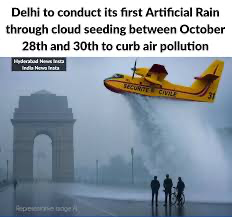
The technique promises to create artificial rain by dispersing particles like silver iodide or rock salt into clouds. Once moisture condenses around these particles, rain can help clear pollutants from the air. On paper, it sounds effective. In practice, results have been far less convincing.
During recent trials, IIT Kanpur Director Manindra Agrawal revealed that the moisture content in Delhi’s clouds was only 15%. For cloud seeding to work, it must reach 50%. The two sorties conducted in October cost nearly ₹60 lakh each, yet they failed to produce any rain.
Even though instruments recorded a 6–10% drop in PM2.5 and PM10 levels, experts argue the improvement was too small to justify the expense. Critics say these results highlight how limited the benefits of cloud seeding in Delhi truly are.
A Short-Term Fix for a Long-Term Crisis
The Delhi government defends cloud seeding as an emergency tool. Officials argue that short-term solutions are necessary while long-term reforms take shape. However, experts see this as a quick-fix approach rather than a real strategy.
Delhi’s toxic air comes from several sources — vehicles, factories, construction dust, and stubble burning. Artificial rain cannot remove these causes. Even if cloud seeding triggers rainfall, the effect lasts only a few days. Once the skies clear, pollution levels return to normal.
Environmental analysts say the government is spending heavily on uncertain results. “Spending crores on cloud seeding while ignoring emissions is like mopping the floor while the tap is still running,” said an air-quality researcher from Gurugram.
Chief Minister Rekha Gupta’s ₹300-crore allocation covers both cloud seeding and other pollution control measures. Of this, ₹25 crore is estimated for multiple winter sorties. Critics argue that the money could be better spent on cleaner public transport, waste management, and renewable energy projects — all of which offer longer-lasting benefits.
Even Agrawal, who led the seeding trials, agrees that the effort is temporary. “It’s not a permanent solution,” he said. “If we control emissions, there will be no need for cloud seeding.”
For now, cloud seeding in Delhi remains an ambitious yet uncertain experiment — one that might bring a few drops of relief but not the downpour the city truly needs.

NewsHasghag operates a 24/7 news bureau that tracks the real-time, social media-driven stories from India and around the world, keeping you ahead of the day’s key talking points. Our digital-first approach transforms storytelling through the seamless integration of data, interactive charts, video, and audio into every narrative