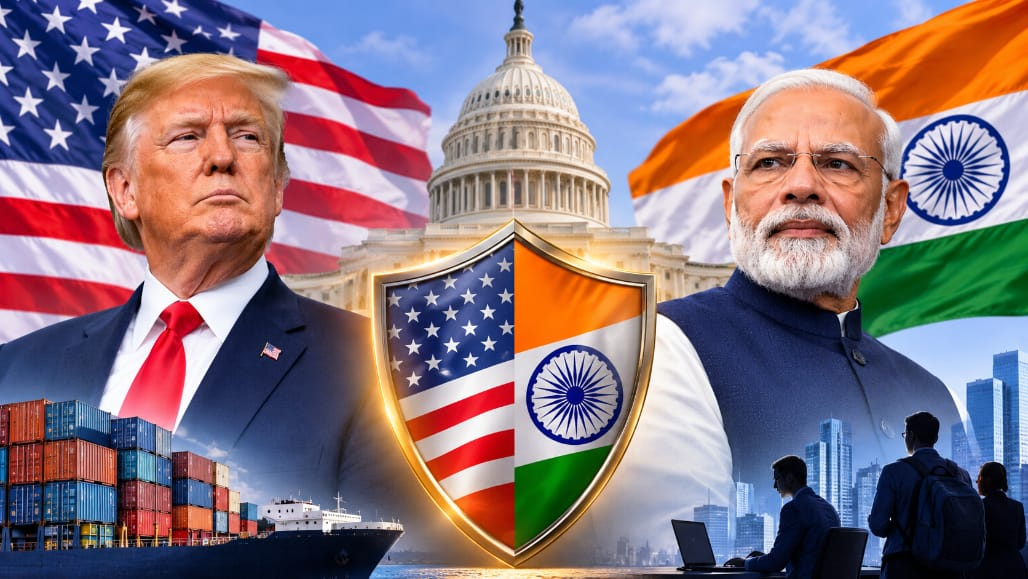





Quad Leaders’ Meet in Manila: A Strategic Reset for the Indo-Pacific
The Quad leaders’ meeting in Manila is more than a diplomatic photo-op. It marks a symbolic return to the city where the grouping first met in 2007 and was revived in 2017, while signalling that India, the United States, Japan and Australia intend to deepen cooperation at a time of growing maritime competition, technological rivalry and security uncertainty in the Indo-Pacific.
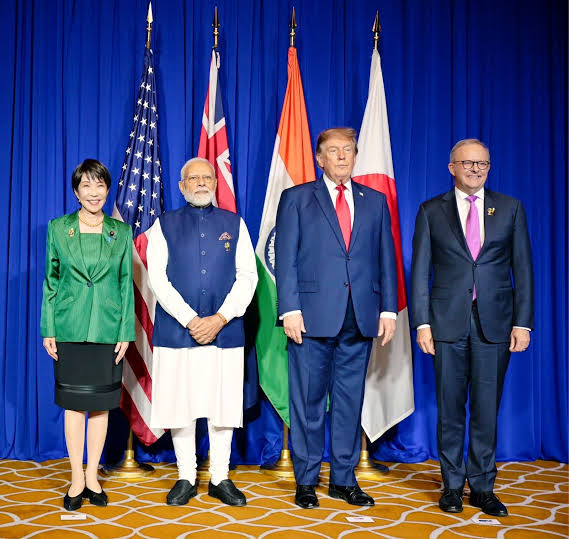
The summit brought together US President Donald Trump, Australian Prime Minister Anthony Albanese, Indian Prime Minister Narendra Modi and Japanese Prime Minister Sanae Takaichi. Their joint statement described the Quad as a “partnership of action” committed to peace, stability and prosperity, with a focus on open, safe and resilient maritime corridors.
What is the Quad?
The Quad, formally the Quadrilateral Security Dialogue, is an informal strategic partnership of four Indo-Pacific democracies: India, the United States, Japan and Australia. It is not a formal military alliance like NATO; instead, it is a flexible platform for coordination on security, maritime safety, technology, infrastructure, public health, climate resilience and economic connectivity.
Its central mission is to support a free, open, inclusive and resilient Indo-Pacific—a region where sea lanes remain open, countries can make sovereign choices, and disputes are resolved through rules rather than coercion. The grouping has increasingly become important because the Indo-Pacific contains major global trade routes, critical supply chains and contested maritime spaces.
How the Quad began
The Quad’s origins lie in the humanitarian response to the 2004 Indian Ocean tsunami. India, Japan, Australia and the United States coordinated relief operations, demonstrating that the four democracies could work together in a crisis.
In May 2007, officials from the four countries held their first formal meeting on the margins of the ASEAN Regional Forum summit in Manila. Japanese Prime Minister Shinzo Abe helped give the idea a broader strategic shape, framing it as a potential network of democracies in the Indo-Pacific.
The grouping then lost momentum after 2007, largely because of political changes in Australia and India and concerns about how China might interpret the arrangement. It remained dormant for a decade before being revived in November 2017—again in Manila—when senior officials met on the sidelines of the ASEAN and East Asia summits.
From dialogue to leaders’ summit
QUAD Leaders Meeting, Tokyo, Japan, May 24, 2022: (L-R) Australian Prime Minister Albanese, U.S. President Biden, Japanese Prime Minister Kishida, and Indian Prime Minister Modi.
The Quad’s revival in 2017 initially focused on connectivity, maritime security, counter-terrorism and non-proliferation. Over time, its agenda expanded as the four countries recognised that regional stability required cooperation beyond traditional defence issues.
A major turning point came in March 2021, when the leaders of the four countries met virtually for the first Quad Leaders’ Summit. This elevated the grouping from an officials-level dialogue into a leaders-driven strategic partnership.
Since then, the Quad has developed practical initiatives in areas such as maritime domain awareness, cybersecurity, critical and emerging technologies, infrastructure, health security and climate resilience. Its value lies not only in strategic signalling but also in its ability to coordinate public goods and capacity-building across the Indo-Pacific.
Why Manila matters
Manila carries special significance for the Quad. It was the location of the grouping’s first official meeting in 2007 and its revival in 2017, making the 2026 leaders’ summit a full-circle moment.
The choice of the Philippines also highlights the Indo-Pacific’s changing security environment. The South China Sea, the Taiwan Strait, the East China Sea and key shipping lanes remain central to regional stability. By meeting in Manila, the Quad leaders reinforced the message that Southeast Asian maritime security is inseparable from the wider Indo-Pacific order.
The summit’s emphasis on open, safe and resilient maritime transit corridors reflects concerns over freedom of navigation, illegal fishing, coercive maritime behaviour, supply-chain disruption and the security of commercial shipping. These issues affect not only the four Quad members but also Southeast Asian states whose economies depend heavily on sea trade.
What was discussed?
The Manila meeting focused on turning broad strategic goals into concrete cooperation. Reported outcomes included a Quad Business Leaders’ Forum, a Super Intelligence Accelerator, a Maritime Intelligence Sharing Corporation and enhanced cybersecurity intelligence-sharing cooperation.
These initiatives show how the Quad’s agenda has broadened from traditional security into economic resilience and advanced technology. Artificial intelligence, cyber defence, secure supply chains and maritime awareness are now treated as strategic priorities because they affect both national security and everyday economic life.
For India, the meeting reinforced its role as a bridge between the Indo-Pacific’s major powers and smaller regional countries. Prime Minister Modi described the Quad as a “trusted partnership” delivering practical solutions, reflecting New Delhi’s preference for a positive, capacity-building agenda rather than an openly confrontational bloc.
Is the Quad anti-China?
The Quad does not formally describe itself as an anti-China alliance. Its public language focuses on a free and open Indo-Pacific, respect for international law, sovereignty and peaceful resolution of disputes.
However, its strategic relevance is inseparable from China’s growing military and economic presence in the region. China’s assertiveness in the South China Sea, its maritime claims, and its expanding technological and industrial capacity have made the Quad increasingly important as a balancing mechanism.
The distinction matters. The Quad is not trying to recreate a Cold War-style military bloc. Its strength lies in offering regional countries an alternative: cooperation based on partnerships, infrastructure, technology and maritime security rather than dependence on a single power.
The Quad’s core challenge
The Quad’s biggest challenge is converting strategic intent into durable results. Its members have different threat perceptions, economic interests and defence capabilities. India, for example, values strategic autonomy and avoids commitments that could limit its independent foreign policy, while the United States, Japan and Australia have closer defence ties with one another.
There is also the question of delivery. Announcements on AI, cybersecurity and maritime intelligence are important, but their impact will depend on funding, implementation, information-sharing protocols and the willingness of governments to sustain cooperation beyond summit headlines.
The grouping must also avoid appearing purely reactive to China. If the Quad is to gain lasting legitimacy in Southeast Asia and the wider Indo-Pacific, it must deliver visible benefits: better maritime domain awareness, disaster response, undersea-cable security, digital infrastructure, supply-chain resilience and economic opportunity.
What it means for India
For India, the Quad offers strategic depth without requiring it to abandon its traditional policy of strategic autonomy. It gives New Delhi a platform to engage with like-minded democracies while preserving its independent relationships with Russia, the Gulf, Southeast Asia and China.
India benefits particularly from cooperation in maritime security, technology, cyber resilience and supply chains. The Indian Ocean region is central to India’s security and trade, and stronger coordination with the US, Japan and Australia can help India protect sea lanes, respond to disasters and build regional partnerships.
At the same time, India will likely continue to resist any framing that turns the Quad into a formal military alliance. New Delhi’s approach is pragmatic: deepen cooperation where it serves national interests, but retain flexibility in its foreign policy.
The road ahead
The Manila summit suggests that the Quad is entering a more operational phase. Its future will depend less on symbolic meetings and more on whether it can build institutions, deliver projects and maintain unity amid shifting political leadership in member countries.
The Quad’s real test will be whether it can offer the Indo-Pacific something more compelling than strategic anxiety: a practical model of cooperation that improves security, strengthens economies and protects the freedom of smaller nations. If it succeeds, the Quad could become one of the defining frameworks of the Indo-Pacific century. If it fails, it risks remaining a high-profile dialogue with limited impact.

NewsHasghag operates a 24/7 news bureau that tracks the real-time, social media-driven stories from India and around the world, keeping you ahead of the day’s key talking points. Our digital-first approach transforms storytelling through the seamless integration of data, interactive charts, video, and audio into every narrative