




El Niño and India’s Rising Heat Risk: Is the Country Ready for a Hotter 2027?
India is entering the next phase of the year with an unusual climate warning. A strengthening El Niño is expected to intensify global temperatures in the months ahead, and a new Climate Impact Lab estimate suggests that the consequences could be severe. The report projects 451,000 additional heat-related deaths globally between September 2026 and February 2027, compared with what would be expected in a normal year. India alone could account for around 15,800 additional deaths during that six-month period. (EPIC)
The numbers are projections, not deaths that have already occurred. But they raise a more immediate question for India: how prepared is the country for a prolonged period of abnormal heat?
El Niño is more than a Pacific Ocean phenomenon
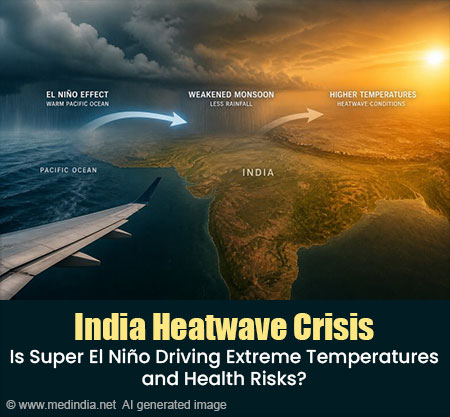
El Niño begins with unusually warm ocean conditions in the tropical Pacific, but its consequences extend far beyond the Pacific. Changes in atmospheric circulation can alter rainfall and temperature patterns across continents. The World Meteorological Organization said earlier this month that El Niño is firmly established and is expected to strengthen into a very strong event, with an almost 100 per cent probability of continuing through February 2027. (World Meteorological Organization)
India is particularly vulnerable because the country’s weather, agriculture and water availability are closely connected to monsoon behaviour. India’s Ministry of Earth Sciences has also said that El Niño conditions that developed during 2026 are likely to persist into February 2027, while cautioning that several other climate factors also influence the Indian monsoon. (Press Information Bureau)
The emerging concern, therefore, is not simply whether temperatures will rise. It is how heat, water stress, agriculture, public health and household incomes could interact.
The Climate Impact Lab estimates that global land temperatures could be about 1.2°C above normal, with extremely hot days occurring about 44 per cent more frequently than in an average year. For India, the projected 15,800 excess heat deaths underline the potential scale of the health burden.
India’s vulnerability lies beyond the thermometer
Heat does not affect everyone equally. Outdoor workers, construction labourers, farmers, street vendors, traffic personnel, elderly people and those without reliable access to cooling are more exposed to prolonged high temperatures.
India has already developed heat-action plans and early-warning systems in several cities and states. But the effectiveness of these measures depends on what happens after an alert is issued.
Is drinking water actually available where people work? Are hospitals prepared for a sudden rise in heat-related illness? Do employers modify working hours during dangerous heat? Are cooling centres accessible to low-income communities? Can electricity networks cope with increased demand for cooling?
These are practical questions that determine whether a heat warning becomes meaningful protection.
The Climate Impact Lab researchers argue that the projections can help governments identify areas where preventive measures could save lives, including better warnings, cooling facilities, hydration access, protection for outdoor workers and additional healthcare capacity.
The heat story could continue into 2027
There is another complication. The forecast window of the report ends in February 2027, but India’s most intense heat season follows soon afterwards. Researchers have warned that the consequences of the El Niño event could extend beyond the six-month projection period. (The Guardian)
That makes the coming months a preparedness window, rather than simply a period for watching temperature forecasts.
India’s experience also shows why national averages can conceal local realities. Delhi, for example, recorded an unusual rainfall surplus during the 2026 monsoon even as nearby Haryana and the broader northwest region experienced deficits. Such departures from familiar weather patterns illustrate how climate variability can complicate conventional assumptions about seasonal conditions.
El Niño is a natural climate phenomenon. But it is arriving on top of a planet already experiencing elevated temperatures because of human-driven climate change. That combination can magnify the consequences of an otherwise temporary climate cycle.
For India, therefore, the warning is not simply about another hot summer. It is about whether heat preparedness can move from seasonal announcements to functioning systems on the ground.
The thermometer may provide the headline. Preparedness will determine the human cost.
Sources: Climate Impact Lab/University of Chicago, WMO, India Ministry of Earth Sciences and Indian media reports. (EPIC)

NewsHasghag operates a 24/7 news bureau that tracks the real-time, social media-driven stories from India and around the world, keeping you ahead of the day’s key talking points. Our digital-first approach transforms storytelling through the seamless integration of data, interactive charts, video, and audio into every narrative