

INDIA Bloc Rally: Rahul Gandhi Leads ‘Chalo Dilli’ March as Akhilesh Yadav, Mamata Banerjee Join Opposition Leaders
NEW DELHI, November 1, 2026: The Congress-led INDIA bloc brought its campaign against alleged electoral irregularities to the streets of the national capital on Sunday, with Rahul Gandhi leading a march towards Ramlila Maidan and senior Opposition leaders, including Mamata Banerjee and Akhilesh Yadav, joining the demonstration. The rally, organised under the banner of ‘Chalo Dilli’, centred on demands for the resignation of Chief Election Commissioner Gyanesh Kumar and raised questions about the credibility of the electoral process.
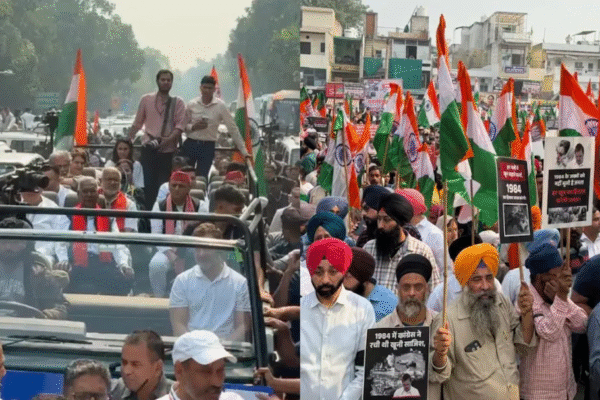
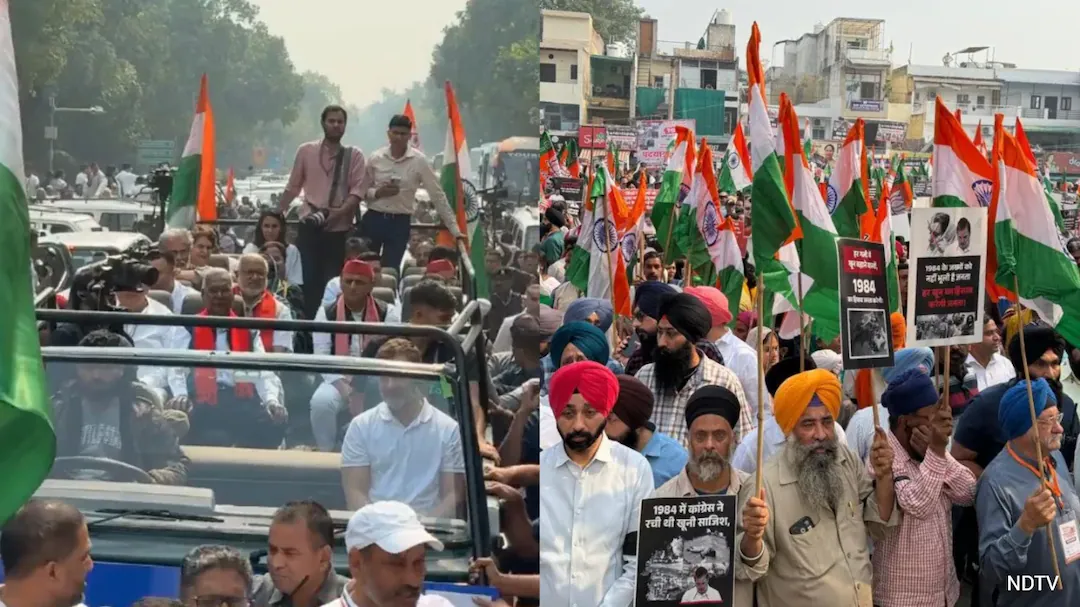
The presence of several prominent Opposition figures gave the demonstration a broader political character. Congress leader Rahul Gandhi led the march from the Minto Road–Connaught Place junction towards Ramlila Maidan. Mamata Banerjee, Akhilesh Yadav, Priyanka Gandhi Vadra, Tejashwi Yadav and National Conference leader Farooq Abdullah were among those accompanying him. Their participation highlighted the INDIA bloc’s attempt to present the issue as a collective Opposition concern rather than a campaign confined to the Congress.
The visual arrangement of leaders during the procession, with Rahul Gandhi at the forefront and other senior figures alongside him, also drew attention. However, the significance of the gathering lies less in the positioning of individual leaders and more in whether the alliance can sustain a common political programme beyond a single demonstration.
Electoral rolls and EVMs at the centre of the protest
The Opposition has accused the Election Commission of irregularities during the Special Intensive Revision (SIR) of electoral rolls. Its leaders allege that eligible voters have been removed from electoral lists and have questioned the transparency of the exercise. The alliance has also renewed its demand for replacing Electronic Voting Machines with paper ballots.
The INDIA bloc is demanding Gyanesh Kumar’s resignation, arguing that the Election Commission must be accountable for concerns surrounding voter registration and electoral procedures. Rahul Gandhi has described the campaign as an effort to defend democracy and constitutional rights.
These allegations remain contested. The Election Commission and the government maintain that the revision exercise is intended to identify duplicate, ineligible and incorrect entries. The central issue, therefore, is whether the process has adequate safeguards, transparency and accessible mechanisms for citizens to challenge errors.
For a democracy of India’s size, electoral roll management is a complex administrative exercise. But the credibility of elections depends not only on the accuracy of voter lists but also on public confidence that eligible citizens are not excluded.
BJP holds counter-march in West Delhi
The Opposition rally coincided with a separate BJP march in West Delhi, organised to remember the victims of the 1984 anti-Sikh riots. The BJP criticised the Congress for holding its demonstration on November 1, a date associated with the anniversary of the violence that followed the assassination of former Prime Minister Indira Gandhi.
The competing programmes brought two different political narratives onto Delhi’s streets. While the INDIA bloc focused on electoral integrity and the Election Commission, the BJP highlighted the historical responsibility of the Congress in connection with the 1984 violence.
The timing has consequently become part of the political debate, with both sides seeking to frame the day’s events around issues they consider central to public accountability.
Heavy security and wider political implications
Authorities deployed thousands of police and paramilitary personnel across central and west Delhi. Barricades, CCTV cameras and drones were used to monitor crowd movement and maintain security. Traffic restrictions and diversions were also introduced around key locations.
The INDIA bloc’s challenge extends beyond assembling leaders and supporters at Ramlila Maidan. Its constituent parties have different regional priorities and political interests. Maintaining unity on electoral reform, voter-list transparency and institutional accountability will require coordination beyond public rallies.
The demonstration also raises a larger institutional question: how can disputes over electoral administration be addressed in a manner that commands public confidence? Allegations must be examined through evidence, transparent procedures and appropriate legal or constitutional channels.
Sunday’s mobilisation has placed the Election Commission and electoral roll revision at the centre of national political discussion. Whether it leads to concrete institutional responses or becomes another episode in the continuing confrontation between the government and Opposition will depend on what follows the rally.
For now, Delhi has witnessed competing political demonstrations, each presenting a different account of democratic accountability. The larger test will be whether the debate produces greater transparency and public trust in India’s electoral process.

NewsHasghag operates a 24/7 news bureau that tracks the real-time, social media-driven stories from India and around the world, keeping you ahead of the day’s key talking points. Our digital-first approach transforms storytelling through the seamless integration of data, interactive charts, video, and audio into every narrative