


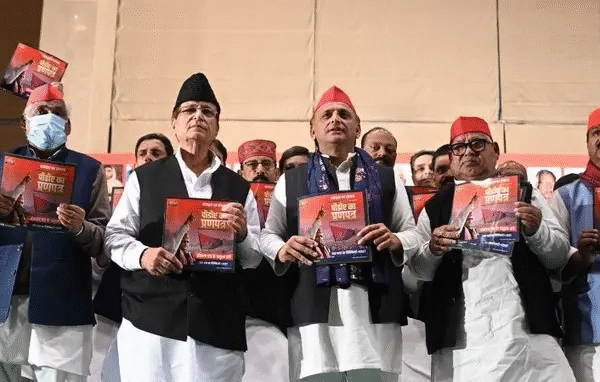
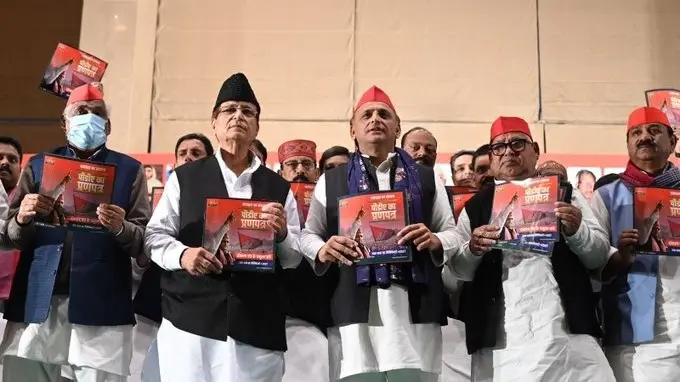
Samajwadi Party (SP) chief Akhilesh Yadav has unveiled the party’s agenda for the 2027 Uttar Pradesh Assembly elections with a manifesto titled “Sattais Ka Sankalp: PDA Ka Pran Patra” (“Resolve of Twenty-Seven: Pledge Document of PDA”). Positioning the document around the party’s Pivoted Dalit, Backward, and Minority (PDA) social coalition, the manifesto puts employment, agrarian relief, social security, and direct financial support at the center of the upcoming state electoral contest.
At the heart of the pitch to young voters is a promise of ₹5,000 per month for unemployed graduates until they secure employment, paired with a pledge to generate 25 lakh government jobs. In Uttar Pradesh—a state with a massive youth population where unemployment, exam leaks, and recruitment delays have repeatedly shaped political debate—these commitments directly target first-time voters, job seekers, and families grappling with sluggish white-collar and public-sector hiring. By linking a monthly stipend to the period before a job is found, the SP is attempting to offer immediate household cushioning alongside a headline employment target.
Agrarian Relief and Employee Demands
For rural households and state employees, the manifesto pairs farm loan waivers with the restoration of the Old Pension Scheme (OPS). Agriculture remains a critical pillar of Uttar Pradesh’s economy and electoral arithmetic, with small and marginal farmers frequently voicing concerns over input costs, crop prices, and debt stress. A debt waiver pledge aims to appeal directly to indebted cultivators ahead of polling, while promising to bring back the Old Pension Scheme speaks to a politically active constituency of government employees, teachers, and civil servants who have long pressed for defined pension benefits over market-linked retirement accounts.
Together, these measures signal a strategy that blends targeted welfare transfers with institutional promises aimed at core constituencies. Rather than focusing on a single grievance, the “Sattais Ka Sankalp: PDA Ka Pran Patra” attempts to stitch together economic relief for unemployed youth, farmers, and public employees under the broader umbrella of PDA representation.
Welfare Arithmetic and Electoral Stakes
The release of the manifesto also underscores how welfare pledges have become a defining battleground in Uttar Pradesh politics. Across recent election cycles, parties in the state have increasingly competed on direct assistance, social welfare schemes, and livelihoods—making the credibility, funding model, and implementation track record of such promises a major point of scrutiny.
For the Samajwadi Party, the challenge ahead of the 2027 elections will be twofold: convincing voters that large-scale commitments—such as 25 lakh public-sector roles, a ₹5,000 monthly graduate allowance, loan waivers, and pension restoration—are fiscally practical and administratively achievable, while keeping its PDA coalition energized across diverse districts. Rival parties, including the ruling Bharatiya Janata Party, are likely to challenge the cost and feasibility of the proposals while highlighting their own governance records and welfare initiatives.
As Uttar Pradesh moves closer to the 2027 Assembly polls, the debate over jobs, farm debt, social security, and direct support is set to test how voters weigh ambitious manifesto pledges against fiscal reality and past performance. Whether “Sattais Ka Sankalp: PDA Ka Pran Patra” reshapes the narrative on the ground will depend on how strongly these issues resonate in rural constituencies, towns, and cities across India’s most populous state.

NewsHasghag operates a 24/7 news bureau that tracks the real-time, social media-driven stories from India and around the world, keeping you ahead of the day’s key talking points. Our digital-first approach transforms storytelling through the seamless integration of data, interactive charts, video, and audio into every narrative