



France’s Budget Deficit Crisis: How Austerity, Teacher Shortages and Education Cuts Fuelled Student Unrest
France, one of Europe’s largest economies and a country renowned for its public education system, is facing an uncomfortable contradiction: its government is struggling to control a mounting budget deficit while students are protesting against overcrowded classrooms, teacher shortages and deteriorating school facilities. The unrest has exposed a difficult question confronting European governments: when public finances deteriorate, who ultimately pays the price?
France’s public deficit stood at 5.8% of gross domestic product (GDP) in 2024 and declined to 5.1% in 2025, according to the European Commission. The deficit is projected to remain around 5.1% in 2026. Meanwhile, public debt is projected to reach 118.1% of GDP in 2026. These figures place France among the eurozone’s most fiscally strained major economies.
Why France’s Budget Deficit Has Become a Political Problem
France’s fiscal difficulties have developed over years. High public expenditure, substantial pension commitments, weak economic growth and rising borrowing costs have made it increasingly difficult for successive governments to balance their books.
The country maintains an extensive welfare state, funding pensions, healthcare, education and other public services. These commitments provide social protection but also create substantial and continuing expenditure obligations. When revenues fail to keep pace with spending, the government must borrow more, raise taxes or reduce expenditure.
The cost of servicing public debt has become an additional burden. The European Commission reported that interest payments rose to 2.2% of GDP in 2025 and projected a further increase to 2.6% in 2026. Money spent servicing existing debt cannot simultaneously be directed towards new public investment.
Political instability has complicated the challenge. Following the fragmented parliamentary election of 2024, building consensus on taxation, pensions and spending has become difficult. The government’s proposed 2027 budget includes a €54 billion package of savings and tax measures intended to bring the deficit under control. The measures have intensified opposition from trade unions, public-sector workers and students.
However, fiscal consolidation is not automatically synonymous with indiscriminate cuts. The real political question is how the burden is distributed—and whether essential public services are protected.
Education Pays the Price of Fiscal Restraint
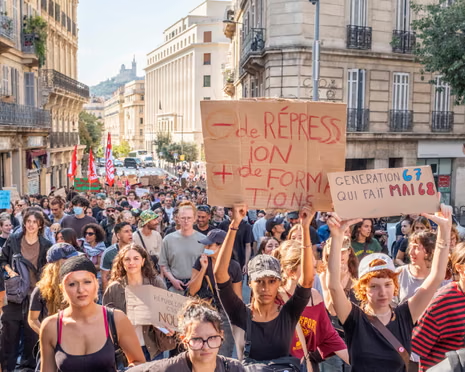
The consequences of prolonged pressure on public spending are particularly visible in French schools. Students have protested against insufficient teaching staff, overcrowded classrooms, inadequate substitute-teacher arrangements and deteriorating buildings.
According to Le Monde, French public secondary education has fewer teachers than it did in 2008, despite serving approximately 250,000 more students. More than 70% of classes in public general and technical high schools have over 30 pupils, while around one-fifth have more than 35. These conditions undermine the individual attention students need to learn effectively.
The problem is not simply the amount allocated to education in a single annual budget. It is also the cumulative effect of staffing decisions, recruitment difficulties, rising operational costs and competing demands on government finances.
A Reuters report published in October 2026 highlighted another pressure: pension costs consume approximately 32% of the Education Ministry’s budget, limiting the resources available for current public services. Education spending as a share of GDP has also declined over the longer term.
There is an important qualification. The proposed 2027 budget reportedly includes a €1.2 billion increase for the National Education Ministry. Nevertheless, teachers’ unions argue that this does not adequately address staffing shortages, classroom conditions and the wider demands on schools. A nominal budget increase does not necessarily translate into sufficient teachers in every classroom.
Student Anger Is About More Than Money
For students, the consequences are immediate. Missing teachers mean missed lessons; overcrowded classrooms reduce individual attention; and poor facilities affect the quality of daily education. These problems also raise concerns about equality, because disadvantaged communities often have fewer alternatives when public schools fail to provide adequate support.
The protests have subsequently joined a wider movement against living costs, deteriorating public services and the government’s budget plans. This expansion demonstrates how a dispute over school conditions can become a broader expression of public dissatisfaction.
France now faces a difficult choice: reduce its deficit without undermining the public services that sustain social mobility and economic opportunity.
A balanced budget is important, but so is an educated generation. If fiscal restraint leaves schools unable to provide enough teachers and adequate learning conditions, the short-term savings may carry long-term costs in productivity, inequality and public confidence.
France’s unrest is therefore not merely a dispute over budget figures. It is a warning that fiscal responsibility must be measured not only by how much a government saves, but also by what society loses in the process.

Prabha Gupta is a veteran journalist and civic thinker dedicated to the constitutional ideals of dignity and institutional ethics. With over thirty years of experience in public communication, her work serves as a bridge between India’s civil society and its democratic institutions. She is a prominent voice on the evolution of Indian citizenship, advocating for a national discourse rooted in integrity and the empowerment of the common citizen