




Samrat Choudhary’s Gaya Visit: Bihar’s Industrial Ambitions Meet the Test of Ground Reality
GAYA, BIHAR | 25 October 2026
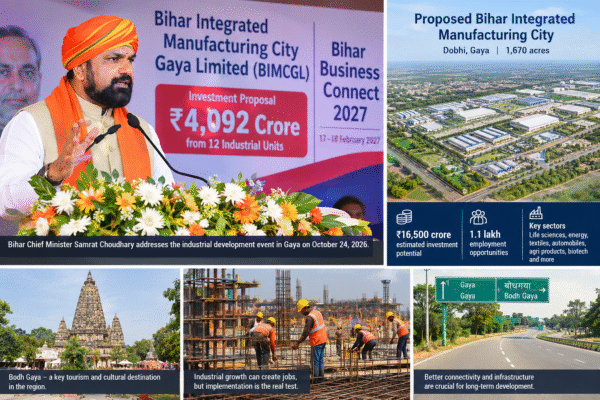
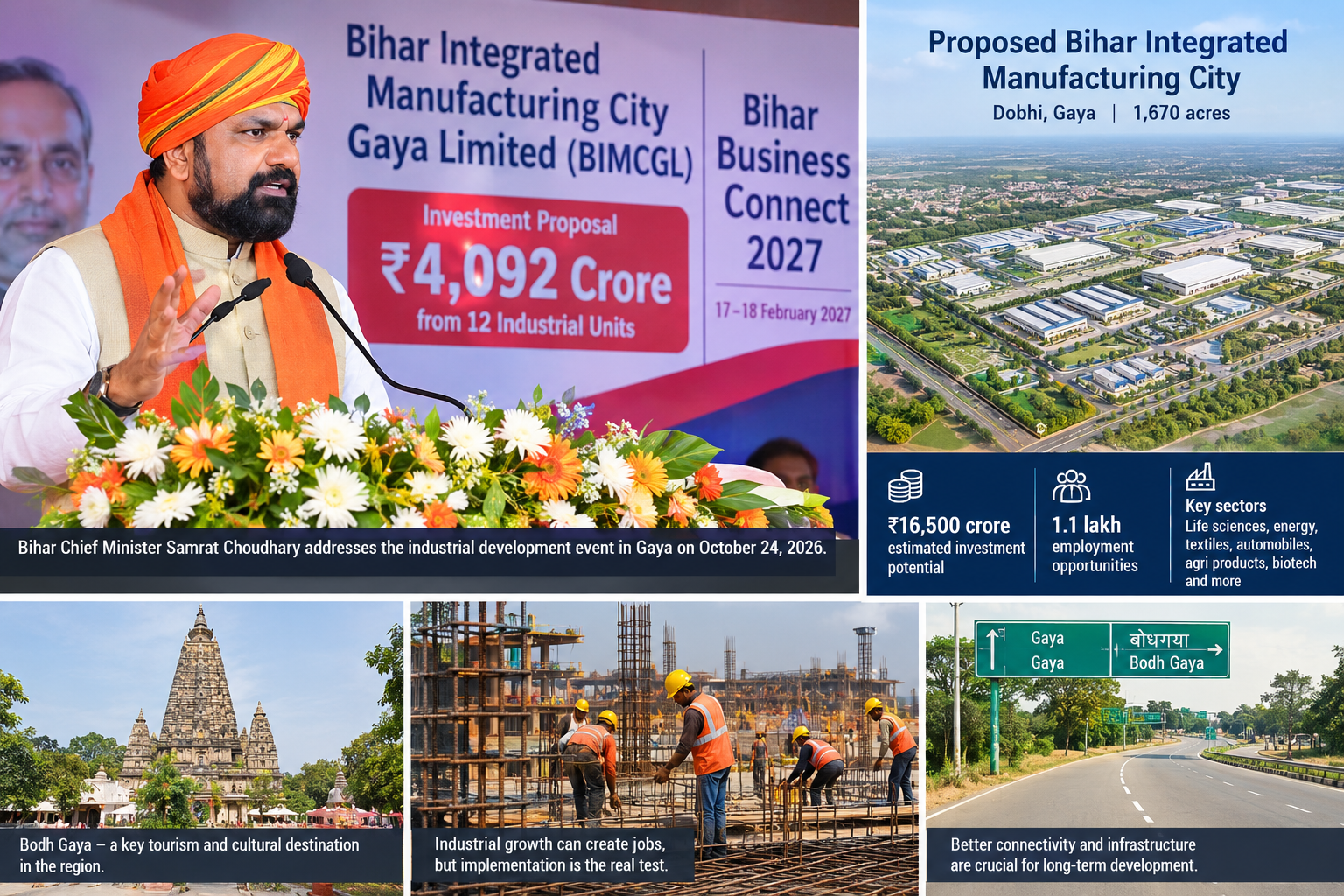
Bihar Chief Minister Samrat Choudhary’s recent visit to Bodh Gaya has put industrial development, investment generation and employment creation at the centre of the state’s economic narrative. At an event held on October 24, the Chief Minister launched Bihar Integrated Manufacturing City Gaya Limited (BIMCGL) and announced investment proposals worth ₹4,092 crore from 12 industrial units. The programme also served as a curtain-raiser for Bihar Business Connect 2027, scheduled for February 17–18 next year. While the announcements signal an effort to reposition Bihar as an industrial destination, the larger question remains whether these commitments will translate into factories, stable jobs and measurable economic gains.
Manufacturing City: Promise and Potential
The proposed manufacturing city, planned across approximately 1,670 acres in Dobhi block of Gaya district under the Amritsar–Kolkata Industrial Corridor, has an estimated investment potential of ₹16,500 crore. According to reports, the project could generate around 1.1 lakh employment opportunities.
The scale of the proposal is significant for a state where employment opportunities and industrial expansion remain major public concerns. However, projected investment and employment figures must not be mistaken for achievements already delivered. The government will need to establish clear implementation timelines, ensure infrastructure readiness and demonstrate that investors are moving beyond expressions of interest.
The announcement of ₹4,092 crore in proposed investments by 12 companies is an encouraging development, but memorandums of understanding do not automatically guarantee that projects will become operational. Land availability, electricity supply, water access, transport connectivity and regulatory efficiency will determine whether the commitments survive the transition from announcement to execution.
The Employment Question
For Bihar’s young population, the ultimate measure of industrial policy is not the number of investment agreements signed but the quality and accessibility of jobs created.
The manufacturing city could support industries spanning life sciences, energy, textiles, automobiles, agriculture-based products, biotechnology and other sectors. Yet the government must clarify how many jobs will be permanent, how many will require specialised skills and how local candidates will access them.
Without strong vocational training, technical education and industry-linked apprenticeship programmes, large industrial projects may struggle to provide meaningful opportunities to the region’s workforce. A credible development strategy must connect investors with local talent rather than allow economic growth to remain disconnected from the aspirations of young people.
The government should also publish company-wise investment milestones, employment commitments and progress reports so that citizens can independently assess performance.
Beyond Industrialisation: The Urban Development Challenge
Choudhary has also highlighted plans for developing 12 townships between Gaya and Bodh Gaya, alongside improvements in infrastructure, tourism and connectivity. The wider vision seeks to combine industrial growth with the region’s historical and religious significance.
Gaya attracts pilgrims, while Bodh Gaya is an internationally recognised Buddhist destination. This combination creates opportunities for tourism, hospitality, transport, retail and small businesses. But rapid urban expansion also raises questions about land acquisition, environmental sustainability, water security, waste management and the protection of cultural heritage.
Development cannot be considered successful if industrial investment comes at the expense of local communities or creates pressure on already stretched civic infrastructure. Transparent land procedures, adequate public consultation and equitable access to economic opportunities must accompany the expansion.
Accountability Beyond Announcements
The October 24 event provides the government with an opportunity to establish a more ambitious industrial trajectory for Bihar. Nevertheless, the real test will begin after the ceremonies end.
Will the proposed investments materialise on schedule? Will factories become operational? Will local people obtain secure employment? Will infrastructure projects be completed transparently and within budget?
These are the questions that should guide public scrutiny.
Bihar needs investment, but it also needs institutional credibility, predictable policies and transparent implementation. The success of the manufacturing city will depend on whether the administration can turn its industrial vision into a functioning economic ecosystem.
Samrat Choudhary’s Gaya initiative may become an important step towards that objective. For now, however, it represents a promise rather than a completed transformation. The government’s credibility will ultimately be measured not by the size of the announced investment but by the number of projects delivered, jobs sustained and lives improved.
The verdict is clear: Bihar’s industrial ambitions deserve serious consideration, but public accountability must remain central. Gaya’s future will be shaped not by announcements alone, but by what actually happens on the ground.

Prabha Gupta is a veteran journalist and civic thinker dedicated to the constitutional ideals of dignity and institutional ethics. With over thirty years of experience in public communication, her work serves as a bridge between India’s civil society and its democratic institutions. She is a prominent voice on the evolution of Indian citizenship, advocating for a national discourse rooted in integrity and the empowerment of the common citizen