


What emerged from BRICS 2026 in New Delhi: A diplomatic balancing act with concrete gains
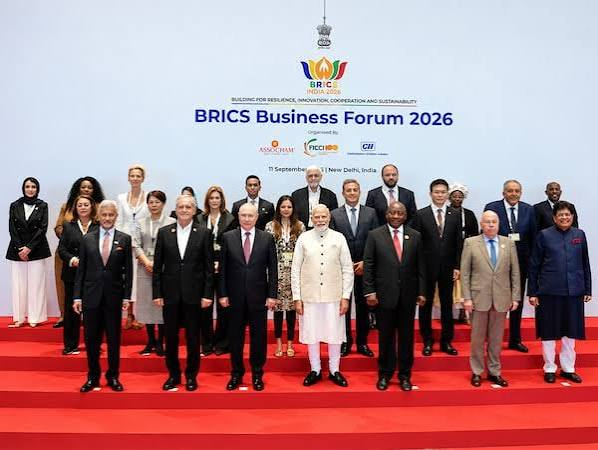
The 18th BRICS Summit in New Delhi concluded with the unanimous adoption of the 140‑point New Delhi Declaration, delivering more than 50 concrete outcomes across trade, finance, technology, security and Global South representation. In a year marked by divergent interests within the 11‑member bloc and heightened geopolitical tensions, India’s chairship is being assessed less on grand announcements and more on its ability to forge consensus, lock in institutional initiatives, and nudge the grouping toward a more coordinated economic and diplomatic posture.
Consensus document as the central achievement
The summit’s headline achievement was the unanimous adoption of the New Delhi Declaration, a 45‑page text that spans UN reform, trade and tariffs, terrorism, West Asia conflicts, artificial intelligence, climate, health and people‑to‑people cooperation. Given BRICS’ expanded membership and well‑known internal differences—particularly between India and China, and across positions on the Middle East and the war in Ukraine—securing full consensus on such a wide‑ranging document is itself a diplomatic win for New Delhi. The declaration reaffirms commitment to multilateralism, calls for a more representative global governance architecture, and explicitly backs greater roles for India and Brazil in reformed global institutions, including the UN Security Council.
Trade, finance and de‑dollarisation: incremental but meaningful steps
On the economic front, the summit produced tangible, if incremental, progress on reducing dependence on the US dollar and deepening intra‑BRICS trade. Member countries signed a Master Agreement on Extending Credit Facility in Local Currency, aimed at boosting trade settlement in national currencies and lowering transaction costs for businesses across the bloc. The declaration also voices strong concern over unilateral tariffs and trade‑restrictive measures, criticises the paralysis at the WTO, and calls for reforms to make the global trading system more equitable for emerging markets and developing countries.
While BRICS stopped short of announcing a single BRICS currency or radical financial architecture, the emphasis on local currency settlement, expanded use of BRICS payment mechanisms, and cooperation on financial risk management signals a steady push towards de‑dollarisation without triggering immediate geopolitical backlash. For India, which has been cautious about overtly antagonising Western financial systems, this calibrated approach allows it to champion Global South financial autonomy while managing its own external risk profile.
Security, terrorism and West Asia: language that matters
On security, the declaration delivers one of India’s key diplomatic objectives: stronger language on cross‑border terrorism, including an explicit condemnation of the April 2025 Pahalgam terror attack in Jammu and Kashmir and a call for “zero tolerance” towards terrorism. For New Delhi, embedding this in a BRICS document—where consensus on terrorism has often been elusive—strengthens its narrative that terrorism is a central threat to regional stability and must be addressed collectively.
On West Asia, the declaration expresses deep concern over escalating hostilities, calls for “maximum restraint”, and rejects “unilateral acts of war”, while also highlighting risks to seafarers and commercial shipping routes. Notably, it avoids explicitly condemning the US‑Israel strikes or Iran’s actions, reflecting the bloc’s internal divisions and the limits of what consensus could achieve on such a sensitive issue. Still, the very act of BRICS articulating a shared position on Middle East escalation, even in guarded language, adds diplomatic weight to calls for de‑escalation and protection of global energy and trade flows.
Technology, AI and innovation: laying groundwork for cooperation
The New Delhi Declaration also marks BRICS’ attempt to move beyond traditional geopolitics into technology governance. Leaders recognise artificial intelligence as a major driver of growth and sustainable development, and endorse deeper cooperation on AI governance, digital public infrastructure, advanced manufacturing and innovation ecosystems. India‑led initiatives on financial risk, AI and related digital frameworks received explicit endorsement, positioning New Delhi as a thought leader within BRICS on how emerging economies can harness technology while managing associated risks.
Institutional deepening and Global South representation
Beyond immediate policy positions, the summit advanced institutional deepening: new or strengthened mechanisms on logistics and supply chains, startups, infectious disease control, and cultural and people‑to‑people exchanges. The declaration repeatedly stresses the need for greater representation of Emerging Markets and Developing Countries (EMDCs) and Least Developed Countries in global decision‑making, backing reforms at the UN, IMF and other Bretton Woods institutions. By anchoring BRICS’ identity more firmly around the Global South, India has helped the bloc present itself not just as an alternative power centre, but as a platform advocating structural changes in global governance.
Limits and the road ahead
Critics note that BRICS 2026 did not produce dramatic breakthroughs on currency union, security alliances or hard positions on major conflicts, and that China arguably gained as much, if not more, from the summit’s outcomes. Yet the real achievement lies in keeping a heterogeneous coalition together, securing consensus on a broad agenda, and locking in practical cooperation mechanisms that can compound over time. With China set to take over the BRICS chair in 2027, the New Delhi outcomes provide a baseline of agreed priorities—from local currency trade to AI cooperation and UN reform—on which future summits can build.

Prabha Gupta is a veteran journalist and civic thinker dedicated to the constitutional ideals of dignity and institutional ethics. With over thirty years of experience in public communication, her work serves as a bridge between India’s civil society and its democratic institutions. She is a prominent voice on the evolution of Indian citizenship, advocating for a national discourse rooted in integrity and the empowerment of the common citizen