



They Have Sold Themselves’: Protesters at Delhi’s ‘Cockroach’ Rally Demand Accountability from the System
New Delhi: “Inquilab Zindabad! Bharat Mata Ki Jai! Jai Bhim!”
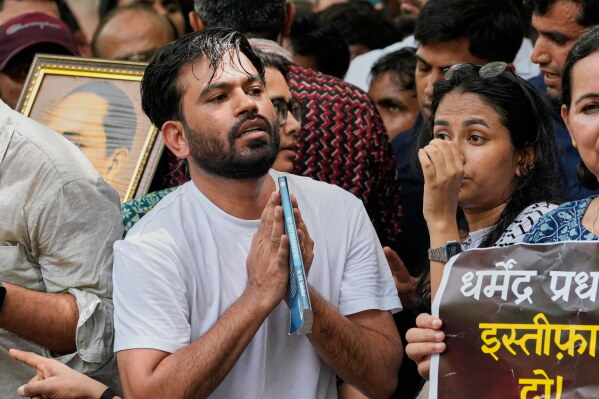
The slogans echoed across Jantar Mantar on Saturday as an unlikely coalition of students, activists, professionals, and ordinary citizens gathered under the banner of the Cockroach Janta Party. What began as an online satirical campaign has now spilled onto the streets, channeling public anger over examination paper leaks, institutional failures, and what many protesters described as a deep crisis of accountability.
The movement was launched in May by social media activist Dipke after reports that the Chief Justice of India had allegedly compared unemployed youth to “cockroaches.” Initially conceived as satire, the campaign quickly evolved into a broader critique of governance, eventually targeting the Narendra Modi government and calling for a public protest in Delhi on June 6.
Interestingly, the slogans chosen by Dipke represented political traditions that are often at odds with one another—Left-wing revolutionary rhetoric, nationalist chants, and Ambedkarite assertions. Yet at Jantar Mantar, ideological differences appeared secondary to a shared sense of frustration.
The dominant demand from the gathering was clear: accountability from those in power, particularly Union Education Minister Dharmendra Pradhan, following a series of examination controversies and paper leaks.
“I have come here to demand the resignation of the education minister,” said Zeenat, a 16-year-old student from Bihar’s Gaya district. She is among the candidates required to retake the undergraduate medical entrance examination on June 21 after authorities cancelled the earlier test.
For many participants, however, the issue extended far beyond one minister.
As conversations unfolded among students, activists, young professionals, and business owners, a common sentiment emerged—diminishing faith in institutions that are supposed to safeguard fairness and public trust.
Youth Anger Over Examination Failures
Zeenat was among nearly 22 lakh students affected by the cancellation of the National Eligibility cum Entrance Test (NEET).
“I feel extremely disheartened,” she said. “I was confident of securing admission to a medical college this year. Then the examination was cancelled. Even my Class XII results did not reflect the effort I had put in.”
To prepare for NEET, Zeenat had moved to Delhi and was staying with her elder sister, Zainab, in Mukherjee Nagar, the capital’s well-known coaching hub. Both sisters attended the protest wearing cockroach masks.
“If authorities cannot conduct an examination properly, what hope do students have?” Zainab asked. “I travelled with her to Bihar in an overcrowded general train compartment because we could not get confirmed tickets. After all that effort, the exam was cancelled. The least the minister can do is take responsibility and resign.”
Aarav Kejriwal, a 16-year-old Class XII student from Noida, echoed the same concern.
“We are here to demand accountability,” he said while distributing campaign flyers. Referring to multiple instances of paper leaks and examination irregularities, he added, “There are too many discrepancies in the system. Someone must be held responsible.”
A Campaign Resonating with Gen Z
Political parties and student organisations have raised concerns about examination leaks for years. Yet many at the protest felt that the Cockroach Janta Party had succeeded in engaging a younger generation in ways traditional political campaigns had not.
Aarav said he discovered the movement through social media and attended despite opposition from his parents.
Student activist Aishe Ghosh attributed the campaign’s appeal to its language and presentation.
“We have been talking about these issues for a long time,” she said. “But sometimes people connect with a different vocabulary, a different style of communication. The campaign has managed to reach young people in a way conventional politics often does not.”
Beyond education-related grievances, several speakers and participants voiced concerns about democratic institutions, including the Election Commission and the broader political system.
One protester alleged that public institutions had failed to uphold their independence, arguing that citizens may increasingly be forced to express their concerns through public demonstrations.
Media Under Fire
If one institution attracted the sharpest criticism at the protest, it was the media.
Repeated chants of “Godi Media Go Back” rang through the gathering, reflecting accusations that sections of the mainstream media have become overly aligned with the government.
Deepak, a 32-year-old PHD scholar attending her first protest, recounted a disappointing interaction with a television journalist.
“I wanted to speak about the problems facing young people,” he said. “Instead, I felt I was being questioned in a way that dismissed my concerns. I came here with hope, but I was unable to express what I wanted to say.”
The criticism of media institutions is also reflected in the Cockroach Janta Party’s manifesto, which calls for greater media independence and stronger scrutiny of corporate ownership and editorial influence.
As the protest concluded, the crowd dispersed, but the message remained unmistakable. Whether students preparing for competitive examinations or citizens disillusioned with public institutions, many participants viewed the rally as a demand not merely for policy change, but for accountability from the systems they believe have failed them.

NewsHasghag operates a 24/7 news bureau that tracks the real-time, social media-driven stories from India and around the world, keeping you ahead of the day’s key talking points. Our digital-first approach transforms storytelling through the seamless integration of data, interactive charts, video, and audio into every narrative