


Summary
- India and Japan sign first-ever defence co-development project agreement.
- Both nations adopt three documents on AI, economic security and energy resilience.
- Japanese Prime Minister Sanae Takaichi visits India with a high-level business delegation.
- Leaders pledge deeper cooperation to strengthen economic growth and Indo-Pacific security.
- Takaichi says India and Japan will leverage each other’s strengths to “grow strong together.”
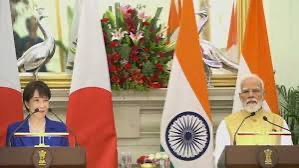
NEW DELHI, July 2: India and Japan on Thursday elevated their strategic partnership by signing a series of agreements covering artificial intelligence (AI), critical minerals, energy security and defence cooperation following bilateral talks between Prime Minister Narendra Modi and his Japanese counterpart Sanae Takaichi.
The two countries also signed their first-ever defence co-development project agreement, marking a significant milestone in bilateral security ties and signalling a shift towards joint defence manufacturing and technology development.
During the meeting, India and Japan adopted three key documents focusing on economic security, energy resilience and artificial intelligence. The agreements reflect the growing importance both nations place on resilient supply chains, emerging technologies and strategic cooperation amid increasing geopolitical uncertainties in the Indo-Pacific region.
Takaichi, who arrived in New Delhi with a large business delegation, described India as an indispensable partner and said the two countries would leverage each other’s strengths to “grow strong together.” Her visit also aims to encourage greater Japanese investment in India’s manufacturing, infrastructure and technology sectors.
Artificial intelligence emerged as one of the central themes of the discussions. Both sides agreed to strengthen collaboration in AI research, digital innovation and responsible technology development to support future economic growth.
Energy security and critical minerals also featured prominently in the talks. As countries worldwide seek reliable access to resources essential for electric vehicles, semiconductors, batteries and renewable energy, India and Japan agreed to deepen cooperation in securing resilient supply chains.
The defence co-development agreement represents one of the most significant outcomes of the visit. While India and Japan have expanded military cooperation through joint exercises and maritime partnerships over the past decade, the new pact takes the relationship a step further by encouraging collaborative defence production and technology development.
Japan remains one of India’s largest investors, contributing significantly to infrastructure projects, industrial corridors and high-speed rail development. The presence of a large Japanese business delegation reflects Tokyo’s growing confidence in India’s long-term economic potential.
The leaders also reaffirmed their shared commitment to maintaining a free, open and rules-based Indo-Pacific, stressing that stronger economic and strategic cooperation would contribute to regional stability and sustainable growth.
The agreements signed on Thursday underline the transformation of India-Japan relations from a traditional economic partnership into a broader strategic alliance centred on technology, security, innovation and resilient supply chains.

Prabha Gupta is a veteran journalist and civic thinker dedicated to the constitutional ideals of dignity and institutional ethics. With over thirty years of experience in public communication, her work serves as a bridge between India’s civil society and its democratic institutions. She is a prominent voice on the evolution of Indian citizenship, advocating for a national discourse rooted in integrity and the empowerment of the common citizen