

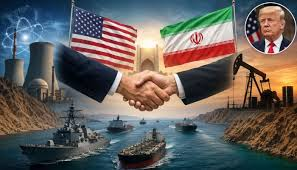
Navigating the 60-Day Truce: Global Markets and Nuclear Regulators Brace for the Next Phase of the US-Iran Accord
The virtual signing of a historic 14-point Memorandum of Understanding (MoU) between US President Donald Trump and Iranian President Masoud Pezeshkian has sent ripples through world capitals. Aimed at bringing an immediate halt to the brutal months-long war that erupted in February, the interim pact extends a fragile ceasefire by 60 days and outlines a step-by-step framework to fully reopen the heavily mined Strait of Hormuz. For a global economy battered by skyrocketing oil prices and choked maritime supply chains, the diplomatic breakthrough offers a critical window of de-escalation, even as deep skepticism persists over its long-term viability.
International reaction has been a mix of immense relief and cautious monitoring. Major energy-importing nations across Asia and Europe were among the first to welcome the deal, recognizing that restoring safe transit through a chokepoint responsible for one-fifth of the world’s petroleum trade is paramount to halting a compounding global inflation crisis. Indian Prime Minister Narendra Modi expressed hope that the implementation phase would prioritize the absolute safety of international seafarers, while regional Gulf states—which have borne the economic and security brunt of spillover strikes—expressed a collective sense of relief. Pakistani and Qatari mediators, who worked intensely to bridge the diplomatic chasm, praised both adversaries for choosing negotiation over an endless war of attrition.
De-Mining the Strait and the Nuclear Countdown
However, the diplomatic triumph in Switzerland is merely the prelude to an incredibly complex technical and military challenge. The core of the deal hinges on a delicate sequence: Iran has agreed to clear its naval mines from the Strait of Hormuz over the next 30 days without charging transit tolls, and in lockstep, the United States will temporarily suspend its suffocating naval blockade on Iranian ports, granting critical waivers for Tehran to resume oil exports.
The most scrutinized front, however, remains Iran’s advanced nuclear infrastructure. International Atomic Energy Agency (IAEA) Director General Rafael Grossi summarized the cautious global consensus perfectly, noting that while the political breakthrough is historic, “now the technical work starts.” Under the framework, Iran must reaffirm its commitment to never acquiring nuclear weapons and agree to allow the IAEA to strictly oversee the “downblending” of its highly sensitive uranium stockpile—which currently includes roughly 440 kilograms of uranium enriched to a dangerous 60% purity. Converting this material back to low-enrichment levels under constant international inspection will be a grueling, high-stakes verification process where any sign of non-compliance could instantly derail the entire accord.
Political High Stakes and Regional Wild Cards
Domestically, the political stakes are extraordinarily high for both leaders. President Trump faces pressure to permanently lower domestic fuel costs ahead of the upcoming midterm elections, though he has already signaled a willingness to abandon the MoU if negotiations stall, bluntly warning that the US could return to military action. In Tehran, despite official state media declaring victory and securing promises of eventual sanctions relief and a massive economic assistance package, ordinary citizens remain highly weary. Months of relentless aerial bombardments and severe blockades have left the domestic economy fractured, and many fear that an interim deal may not translate into tangible economic stability.
Furthermore, the exclusion of concrete enforcement mechanisms regarding Israel’s ongoing border friction with Hezbollah looms as a volatile wild card that could shatter the 60-day window. If the technical negotiations collapsing under the weight of decades of mutual distrust do not break the truce, an uncoordinated regional flashpoint very well might.
Prabha Gupta is a veteran journalist and civic thinker dedicated to the constitutional ideals of dignity and institutional ethics. With over thirty years of experience in public communication, her work serves as a bridge between India’s civil society and its democratic institutions. She is a prominent voice on the evolution of Indian citizenship, advocating for a national discourse rooted in integrity and the empowerment of the common citizen