



Yamuna’s Toxic Foam and Chhath Puja: AAP Calls It a Cleanup Show
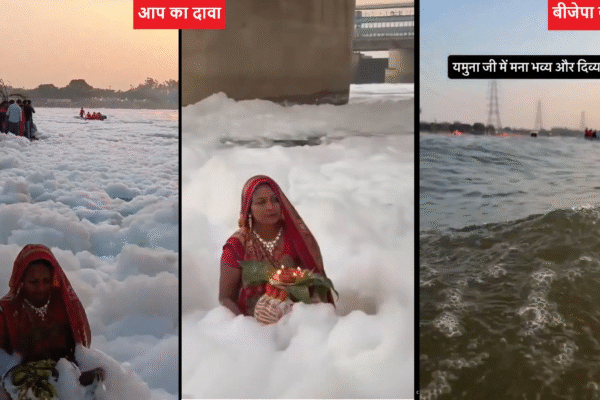
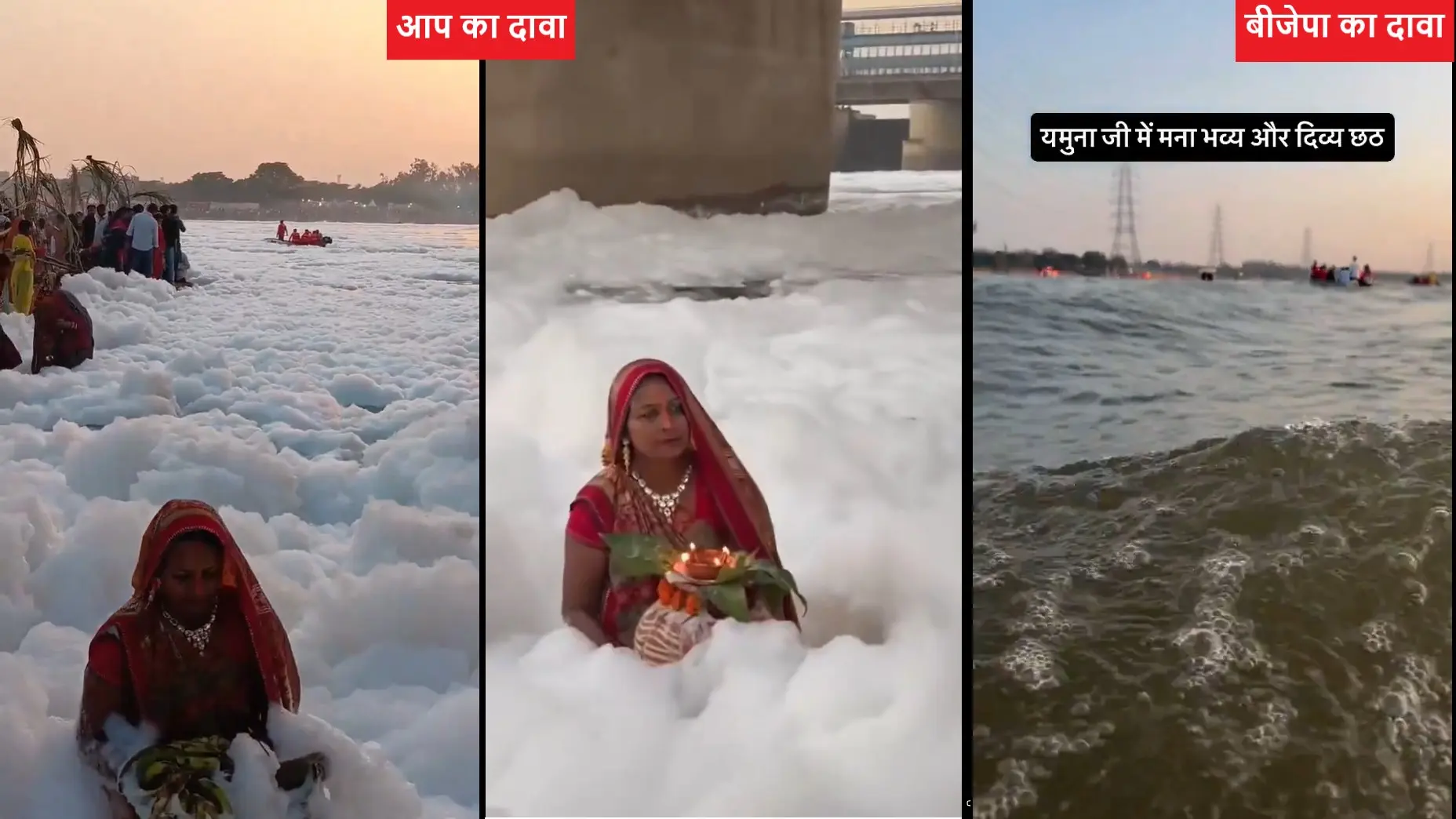
Yamuna’s toxic foam during Chhath Puja, dead fish, and a political war—AAP calls it a “clean-up spectacle,” while the BJP calls it a conspiracy to defame Delhi. The Aam Aadmi Party has accused the Rekha Gupta-led Delhi government of failing to clean the river, while the BJP has rejected the charge and alleged that AAP is trying to tarnish the administration’s image.
The dispute has intensified at a moment when devotees gather at the riverbank for Chhath Puja, only to be confronted by thick foam, polluted water and reports of dead fish near Sonia Vihar. AAP leaders have cited visuals from Kalindi Kunj to argue that the government’s cleaning claims are exposed, while the BJP has pointed to cleaner stretches near ITO and accused its rivals of selective imagery and political opportunism.
Why the Yamuna foams
The foam is not merely a visual nuisance. It is mainly caused by surfactants—chemical compounds commonly found in detergents—along with phosphates and organic pollutants entering the river through untreated or partially treated sewage. When wastewater containing these substances is released through barrages or drains, the turbulence traps air in the water and creates persistent froth.
Delhi’s own government has acknowledged that untreated sewage from unauthorised colonies without functional sewer connections, along with wastewater flowing in from Haryana through the Najafgarh drain and from Uttar Pradesh through the Hindon cut canal, are major contributors. Detergents used in households, dhobi ghats and dyeing industries add phosphates and surfactants to this load.
Is it AAP’s failure or BJP’s?
Both parties bear responsibility, but in different ways. AAP governed Delhi for a decade and repeatedly promised to clean the Yamuna; its critics argue that the persistence of froth, untreated drains and inadequate treatment capacity shows that those promises were not fulfilled. The BJP, now leading Delhi’s government, argues that it inherited a polluted river and years of unfinished sewerage and treatment infrastructure.
The more accurate answer is that the Yamuna’s crisis is institutional and infrastructural, not the creation of one party alone. Delhi’s sewage system has long struggled to keep pace with the city’s population, unplanned growth and the volume of wastewater generated every day. Official assessments have identified untreated or partially treated sewage as the principal pollution load, alongside gaps in industrial effluent treatment and delays in upgrading sewage-treatment projects.
| Factor | Who is responsible | Why it matters |
|---|---|---|
| Untreated and partially treated sewage | Delhi government, municipal bodies, previous administrations | The largest source of the river’s pollution load; sewage contributes about 80% of it, according to a committee report. |
| Sewage-treatment capacity and performance | Delhi Jal Board, Delhi government, contractors | Treatment plants must be expanded, upgraded and operated reliably; underuse and poor standards mean pollutants still reach the river. |
| Industrial effluents | Industries, pollution-control bodies, state agencies | Many industrial clusters discharge into the Yamuna or its tributaries; several lack adequate Common Effluent Treatment Plants, while existing CETPs are underutilised. |
| Pollution from Haryana and Uttar Pradesh | Upstream state governments and agencies | Wastewater entering Delhi through the Najafgarh drain and Hindon cut canal worsens pollution before it reaches downstream stretches. |
| Foam management | Current Delhi administration | Defoamers and temporary clean-ups may improve appearance before festivals but do not remove the underlying pollutants. |
The core problem: sewage, not just foam
The Yamuna is most polluted in the roughly 22-kilometre Delhi stretch between Wazirabad and Okhla, where more than 20 drains discharge sewage and effluents into the river. This stretch alone contributes more than half of the pollution load, turning a river that is relatively cleaner upstream into a heavily contaminated channel by the time it flows through the capital.
Delhi generates far more wastewater than its system can reliably treat. Older assessments estimated that the city produced about 2,871 million litres per day of sewage against an installed treatment capacity of 1,478 MLD, leaving a huge volume untreated or only partially treated. More recent official information cited a treatment gap of 414 MLD in August 2025, showing that the problem remains substantial even after years of investment.
The result is a river that receives a continuous mix of domestic sewage, detergent-laden wastewater, industrial discharge and solid waste. Chhath Puja does not create this crisis; it makes it visible when thousands of devotees gather at the ghats and the river’s condition becomes impossible to ignore.
Will the Yamuna ever be cleaned?
Yes—but not through festival-time spraying, political slogans or one-off clean-up drives. The Yamuna can be substantially restored, but only if Delhi and its neighbouring states treat the river as a shared drainage and ecological system rather than a symbolic political battlefield.
A credible clean-up would require:
- Zero untreated sewage: Every major drain must be intercepted and connected to functioning treatment infrastructure; sewage must not be allowed to bypass plants during rain or maintenance.
- Upgraded treatment plants: STPs need higher capacity, better operation and stricter compliance with discharge standards, especially for phosphates, surfactants and ammonia.
- Industrial accountability: Every polluting cluster needs an effective CETP or individual effluent-treatment system, with real-time monitoring and penalties for violations.
- Inter-state coordination: Delhi cannot clean the Yamuna alone if polluted water continues
- Protection of the floodplain: Encroachments, construction waste, farming and solid-waste dumping in the floodplain must be controlled.
- Long-term funding and timelines: Authorities have themselves indicated that upgrading sewage-treatment infrastructure to reduce frothing could take at least three to five years.
What citizens should demand
The political fight may decide elections, but it will not clean the river by itself. Voters should ask both AAP and the BJP for dated, measurable commitments: how many drains will be tapped, by when; how much additional sewage-treatment capacity will be created; which industrial clusters will be connected to treatment systems; and what water-quality targets will be publicly reported.
Until untreated sewage stops entering the Yamuna, foam will return after every clean-up, dead fish will remain a warning sign, and Chhath Puja will continue to expose the gap between political promises and the river’s reality. The Yamuna is not beyond saving—but saving it demands sustained infrastructure, inter-state cooperation and accountability that outlasts a news cycle.

Prabha Gupta is a veteran journalist and civic thinker dedicated to the constitutional ideals of dignity and institutional ethics. With over thirty years of experience in public communication, her work serves as a bridge between India’s civil society and its democratic institutions. She is a prominent voice on the evolution of Indian citizenship, advocating for a national discourse rooted in integrity and the empowerment of the common citizen