






RSS at 100 — Part 3: Who Funds the RSS? Guru Dakshina, Donations and the Tax Question
Two-Line Summary
The RSS has long described Guru Dakshina and voluntary contributions as central to its financial model. But how are these contributions legally treated, what does Indian tax law say, and how much can the public know about the finances of an organisation that is not registered as a society?
Why This Investigation Matters
Money is one of the most important questions surrounding any organisation that operates on a national scale.
The Rashtriya Swayamsevak Sangh has thousands of shakhas, full-time workers, offices, properties, publications, training programmes and a wide network of activities. Yet unlike a conventional registered society or company, the RSS does not publish the kind of financial information that many registered institutions routinely make available to the public.
This has led to two very different narratives.
Critics ask how an organisation of such scale can operate without greater financial disclosure. Supporters, meanwhile, point to the RSS’s volunteer-driven structure and its tradition of Guru Dakshina—voluntary contributions made by swayamsevaks—as the foundation of its finances.
In November 2025, RSS chief Mohan Bhagwat publicly described the organisation as a body of individuals and said its voluntary contributions, referred to as Guru Dakshina, were exempt from income tax. He also said that the Income Tax Department had sought tax from the organisation in the past but that courts had subsequently provided relief.
That statement makes the tax question especially important.
What exactly is Guru Dakshina?
Is it legally a donation?
Is every contribution made to the RSS treated in the same way?
Does the RSS itself have taxable income?
And if some income is exempt, under which legal provision and on what basis?
These are questions that require more than political claims. They require looking at the tax framework and the organisation’s own position.
What Is Guru Dakshina?
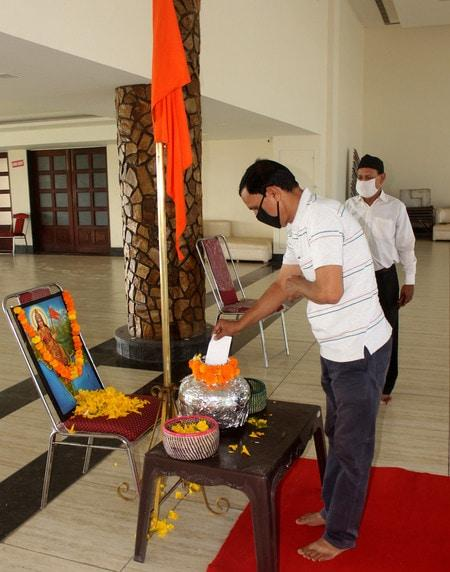
Guru Dakshina is an established tradition within the RSS through which swayamsevaks make voluntary monetary contributions to the organisation.
The practice is closely associated with the RSS’s symbolic relationship with the Bhagwa Dhwaj, or saffron flag, which is treated within the organisation as its Guru. Contributions are therefore not presented by the RSS as a conventional membership fee or commercial payment.
This distinction is important because the character of a payment can have legal and tax consequences.
The RSS has repeatedly described its financial model as being based primarily on voluntary contributions rather than compulsory membership fees.
That model fits the organisation’s broader philosophy of volunteerism. A person may participate in a shakha without becoming a salaried employee, and organisational work is carried out extensively by volunteers.
But the existence of voluntary contributions does not, by itself, answer the tax question.
The relevant issue is how the law characterises the recipient, the contribution and the income generated from it.
Is Every Voluntary Contribution Tax-Free?
No general conclusion should be drawn that simply calling a payment Guru Dakshina makes it automatically exempt from taxation.
Indian income-tax law contains different provisions for different categories of persons and entities.
The Income Tax Department explicitly recognises an Association of Persons (AOP) or Body of Individuals (BOI) as a “person” under Section 2(31) of the Income Tax Act, 1961, whether incorporated or not. It also separately recognises trusts and institutions that may qualify for specified exemptions.
This matters because the absence of incorporation does not automatically place an organisation outside the income-tax system.
In other words, “not registered as a society” does not mean “outside income-tax law.”
The tax treatment must be determined according to the organisation’s legal character, sources of income, applicable provisions and any exemptions available to it.
That is why the question cannot be settled simply by saying that the RSS is unregistered.

The RSS’s Position on Tax
The RSS has a different interpretation of its financial structure.
Mohan Bhagwat said in November 2025 that the organisation functions as a body of individuals and that its Guru Dakshina contributions are exempt from income tax. He also referred to earlier disputes with tax authorities and said courts had ultimately exempted the contributions.
This is an important statement because it represents the RSS’s own explanation of its tax position.
But journalism requires a distinction between what an organisation says about its tax treatment and what the underlying legal record establishes.
The two should not automatically be treated as identical.
The appropriate next step is therefore to examine the judicial and tax records behind the RSS’s claim.
What Does the Income Tax Department Say About Associations?
The Income Tax Department’s current guidance makes one point particularly clear: an AOP or BOI can be treated as a taxable “person” whether or not it is incorporated.
The department also provides specific frameworks for charitable and religious trusts and institutions to obtain tax benefits, subject to the conditions prescribed by law. Its guidance lists registration and approval mechanisms for eligible entities seeking exemptions under the Income Tax Act.
This means the tax system does not operate on a simple registered-versus-unregistered divide.
There can be different legal categories, and different categories can have different tax consequences.
Therefore, the question for the RSS is not simply:
“Is it registered?”
It is:
“Under which legal category is the RSS assessed, what income does that category recognise, and what exemptions or judicial rulings apply?”
That is a much more precise question.
Guru Dakshina and the Principle of Mutuality
The RSS’s tax argument has also been discussed in relation to the principle of mutuality—the broader tax concept under which certain receipts arising from dealings between members of an organisation and the organisation itself may, depending on the facts and applicable law, receive different treatment from ordinary commercial income.
However, this principle should not be casually described as a blanket tax exemption for every contribution made to an association.
The legal treatment depends upon the facts and the applicable judicial interpretation.
That distinction is particularly important in the case of the RSS because Guru Dakshina is described as a contribution from swayamsevaks, rather than a payment for a commercial service.
The question, therefore, is not simply whether money enters the organisation.
It is what the money represents in law and how the courts and tax authorities have treated it.
What About Donations From Outside the RSS?
Another question concerns money received from people who may not participate regularly in RSS shakhas.
The word “donation” is often used broadly in public discussions, but different kinds of receipts can have different legal implications.
A contribution from a swayamsevak described as Guru Dakshina may raise one set of legal questions.
A donation from an outside individual or institution may raise another.
A grant from a government body would raise yet another set of questions.
And funding received by a legally separate organisation associated with the wider Sangh network cannot automatically be treated as income of the RSS itself.
This distinction is essential.
The RSS is at the centre of a much larger ecosystem of organisations operating in fields such as education, labour, student activities, social service and other areas. Many of these organisations have their own legal identities.
Therefore, the finances of RSS itself should not automatically be conflated with the finances of every organisation associated with the broader Sangh Parivar.
That would create an inaccurate picture in either direction.
How Much Money Does the RSS Collect?
This is one of the most difficult questions to answer from publicly available information.
The RSS does not publish a conventional annual financial report that allows an ordinary reader to see, in one place, its nationwide income from Guru Dakshina, other contributions, expenditure, assets and liabilities.
Does the RSS Pay Income Tax?
This is perhaps the most frequently misunderstood question.
The simple statement “RSS does not pay tax” is incomplete unless it specifies what tax, on what income, for what period and under what legal provision.
The RSS has publicly argued that its Guru Dakshina is exempt from income tax.
Political critics have challenged that position and demanded greater disclosure. In November 2025, Karnataka minister Priyank Kharge alleged that the RSS had avoided registration to stay outside the tax ambit. The RSS’s position, as reported at the time, was that registration was not compulsory and that its voluntary contributions were exempt.
These are competing claims.
A responsible investigation should not present either political assertion as a judicial finding.
Instead, the question should be tested against the relevant tax provisions and court decisions.
Registration and Taxation Are Two Different Questions
Part 2 established an important principle: the RSS’s lack of registration as a society does not automatically make it illegal.
Part 3 establishes another:
Lack of society registration does not automatically determine tax liability.
The Income Tax Department itself recognises unincorporated AOPs and BOIs as taxable “persons”.
At the same time, tax law provides exemptions and special regimes for qualifying entities under specified conditions.
Therefore, the fact that the RSS is not registered as a society cannot by itself establish either that it owes tax on all its receipts or that all of its receipts are exempt.
The answer depends upon the legal and factual classification of those receipts.
That question will therefore be addressed separately in the later part of this investigation dealing with Mohan Bhagwat’s security.
The Transparency Question
There is an important distinction between financial legality and financial transparency.
An organisation may comply with the tax law applicable to it and still face questions about how much information it voluntarily makes public.
Similarly, the absence of publicly available financial statements does not, by itself, establish financial misconduct.
For the RSS, the issue is therefore not simply whether it is “tax-free”.
The larger question is:
How much financial information should an organisation of such national scale make available to the public?
That is a legitimate question of institutional accountability.
The answer could involve voluntary disclosure, independent auditing, publication of financial summaries or greater clarity about the relationship between the central organisation, regional units and associated bodies.
The Bigger Picture
The RSS’s financial model is closely connected to its organisational philosophy.
It relies heavily on volunteers rather than salaried employees. It does not operate like a conventional company. Its local shakhas are relatively inexpensive compared with large institutional structures. And Guru Dakshina has historically been presented as a voluntary contribution rather than a compulsory fee.
This model helps explain how the organisation has been able to build a large grassroots network without operating like a conventional corporation.
But scale changes the nature of the accountability question.
When an organisation operates across thousands of locations and has substantial influence on public life, questions about its finances are not inherently hostile.
They are questions that any major institution may reasonably be asked.
What the Evidence Establishes—and What It Does Not
The evidence currently available allows several conclusions.
The RSS is not registered as a society under the Societies Registration Act.
Its leadership describes it as a body of individuals operating through voluntary contributions and has specifically defended the tax treatment of Guru Dakshina.
Indian income-tax law recognises unincorporated AOPs and BOIs as taxable persons, demonstrating that incorporation or society registration is not the sole determinant of tax treatment.
At the same time, public political claims that the RSS is either “completely tax-free” or “avoiding tax by remaining unregistered” require more specific documentary evidence before they can be treated as established facts.
The biggest unresolved issue is therefore not simply whether the RSS pays tax.
It is how its financial structure works and how much of that structure is independently visible to the public.
Questions That Remain
How much does the RSS collect annually through Guru Dakshina?
Are detailed accounts maintained at the central, regional and local levels?
Who audits those accounts?
What tax returns are filed by the RSS, if any?
What specific judicial decisions underpin the organisation’s position on Guru Dakshina?
Are there other sources of income beyond voluntary contributions?
How are properties and other assets held?
And how clearly can the finances of the RSS itself be distinguished from those of the wider network of organisations associated with the Sangh?
These questions deserve documentary answers rather than political accusations.
What Comes Next
Money is only one part of the RSS story.
The organisation has repeatedly said that it is not a political party. Yet many senior BJP leaders have had backgrounds in the RSS, and the ideological and organisational relationship between the two has been debated for decades.
The BJP is a registered political party that contests elections and seeks governmental power. The RSS describes itself as a socio-cultural organisation that does not contest elections.
So where exactly do the two organisations meet?
How did their relationship develop?
How much organisational overlap exists?
Does the RSS influence BJP decision-making?
And where does the institutional independence of one organisation end and the political role of the other begin?
Part 4 of the NewsHashtag investigation will examine the RSS-BJP relationship—its history, areas of overlap, institutional differences and the evidence behind competing claims.
Sources & Documents
This investigation uses the Income Tax Department’s current guidance on AOPs/BOIs and tax treatment, official tax forms and publicly reported statements by RSS chief Mohan Bhagwat concerning Guru Dakshina and the organisation’s tax position.
Political claims regarding the RSS’s registration and taxation have been reported separately and are presented as claims rather than established findings.
Editor’s Note: This article distinguishes between an organisation’s own position, political allegations and what can be established from law and public records. The terms Guru Dakshina, donation, contribution and taxable income should not be treated as legally interchangeable without examining the relevant facts and provisions.

Prabha Gupta is a veteran journalist and civic thinker dedicated to the constitutional ideals of dignity and institutional ethics. With over thirty years of experience in public communication, her work serves as a bridge between India’s civil society and its democratic institutions. She is a prominent voice on the evolution of Indian citizenship, advocating for a national discourse rooted in integrity and the empowerment of the common citizen