







RSS at 100 — Part 2: What Is the Legal Status of the RSS?
Two-Line Summary
The RSS is widely described as an unregistered organisation, but does being unregistered mean that it is illegal? The answer requires looking beyond social-media claims at the Societies Registration Act, the organisation’s own constitutional history and judicial records.
Why This Investigation Matters
Few questions about the Rashtriya Swayamsevak Sangh have generated as much confusion as its legal status. A claim frequently repeated on social media is that the RSS is “not registered” and therefore operates outside the law. Another claim goes further, suggesting that an organisation of its size cannot legally function without registration.
Neither proposition should be accepted without examining the law.
The more precise question is this: Is the RSS registered as a society or another conventional legal entity, and does Indian law require every voluntary association to obtain such registration merely to exist and function?
The distinction matters. Registration under a particular law can provide an organisation with a defined legal framework, reporting obligations and certain rights. But the absence of registration under one statute does not automatically establish that an organisation is unlawful.
For an organisation as influential as the RSS, however, another question remains equally important: what legal and financial framework actually governs it?
That is the question this part of the NewsHashtag investigation examines.
Is the RSS Registered as a Society?
Available judicial records and recent reporting indicate that the RSS is not registered as a society under the Societies Registration Act, 1860. A 1993 Delhi High Court judgment, for example, described the RSS as not being a society registered under the Societies Registration Act, 1860 or a body corporate constituted by statute.
The position has also surfaced in more recent litigation. In a 2018 Bombay High Court matter concerning an attempt by an individual to register a society using the name “Rashtriya Swayamsevak Sangh”, the court record referred to an earlier decision of the Assistant Registrar of Societies, Nagpur, rejecting that application. The case concerned the proposed registration of a society under the RSS name; it should not be confused with an application by the RSS itself to register as a society.
The important point, therefore, is relatively straightforward: the RSS is not a society registered under the Societies Registration Act.
But that statement by itself does not answer the larger legal question.
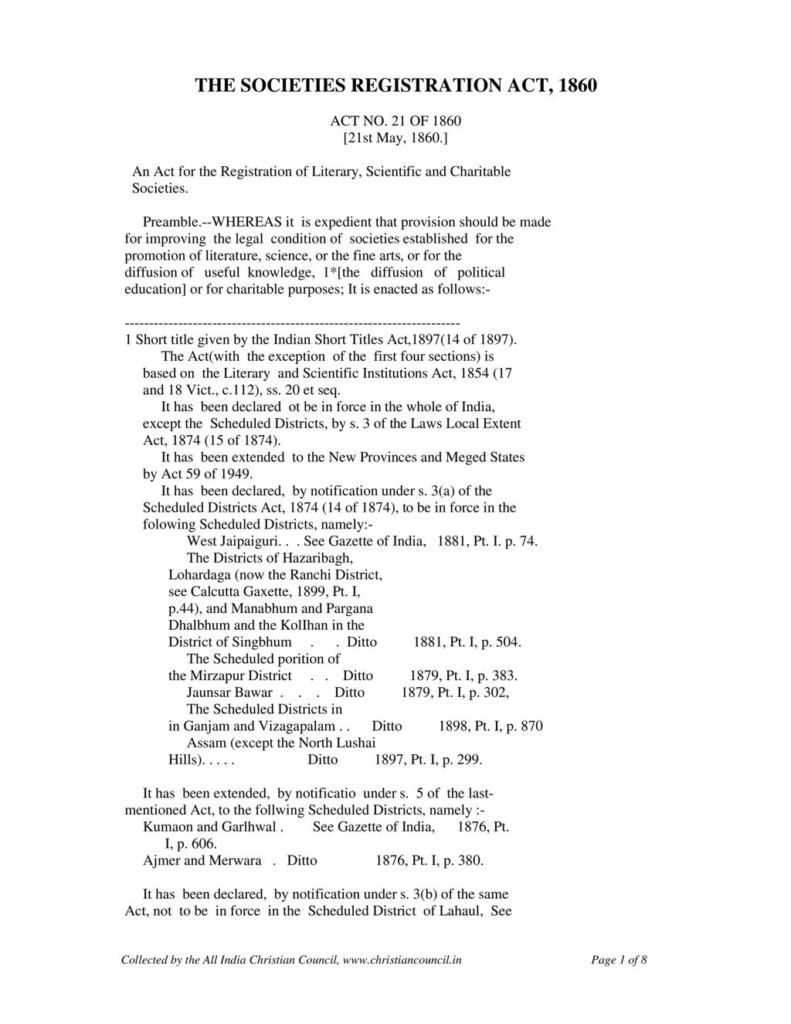
What Does the Societies Registration Act Actually Say?
The Societies Registration Act, 1860, was enacted to provide a legal framework for societies established for specified purposes, including literary, scientific and charitable purposes. Section 1 says that seven or more persons associated for qualifying purposes may, by subscribing their names to a memorandum and filing it with the Registrar, form themselves into a society under the Act.
The Act provides a mechanism for creating a registered society. It does not, in its central formulation, say that every association of citizens in India must register under this Act.
There are also different state amendments and state-level laws governing societies, meaning that the legal position cannot always be reduced to one sentence applicable identically across the country.
This is one reason the statement “RSS is unregistered, therefore RSS is illegal” is too simplistic.
The legal question is not merely whether an organisation possesses a society registration certificate. It is whether its activities, property, finances and other dealings comply with the laws that apply to those activities.
Unregistered Does Not Automatically Mean Illegal
Indian law recognises different forms of associations and different legal consequences depending upon the form in which an organisation operates. The Income Tax Department, for example, explicitly recognises an Association of Persons or Body of Individuals as a “person” for income-tax purposes, whether or not it has been incorporated.
That does not mean every unregistered association automatically enjoys tax exemption. Nor does it mean that every organisation can avoid regulatory requirements simply by calling itself an association.
It means something more basic: legal personality, registration under a particular statute and tax treatment are separate questions.
The 1948 Ban and the 1949 Constitution
The RSS’s legal history also cannot be separated from the government’s decision to ban the organisation in 1948 following Mahatma Gandhi’s assassination.
The ban was lifted in 1949. The RSS itself records that a written constitution was drafted in that period and that the government lifted the ban on July 12, 1949.
This episode is significant because it demonstrates that the question of the RSS’s organisational status is not new.
The organisation had already come under direct government scrutiny decades before the present debate over registration.
After the ban was lifted, the RSS continued to function as a voluntary organisation rather than converting itself into a conventional registered society.
That decision became part of the organisational model that continued for decades.

What Does the RSS Say?
The RSS has consistently maintained that registration is not legally necessary for it to function as a voluntary organisation.
In November 2025, RSS chief Mohan Bhagwat publicly addressed the issue during the centenary period. According to reports, he argued that the government had not made registration mandatory and pointed to the fact that the organisation had been banned and subsequently allowed to function again.
The RSS’s position, therefore, is not that it secretly exists outside the law. Its argument is that registration under the Societies Registration Act is not a prerequisite for the existence of the organisation itself.
That is an important distinction from the claim circulating online that the RSS is simply an “illegal organisation”.
At the same time, the RSS’s position should not end the investigation. A major voluntary organisation can be legally permitted to function while still facing legitimate questions about its internal governance, financial disclosure and accountability.
What Do the Courts Tell Us?
Judicial records provide a more nuanced picture than political arguments on either side.
A 1993 Delhi High Court judgment described the RSS as an organisation that had adopted a written constitution but was not registered under the Societies Registration Act or incorporated under a statute.
More recent legal proceedings have again brought the issue into focus. In June 2026, the Indian Express reported on renewed controversy over the RSS’s lack of registration and noted that the organisation’s position has long been that there is no general legal requirement for every association to register.
The legal record therefore does not support a simple conclusion that “unregistered means illegal”.
But it does establish something equally important for an investigative journalist: the RSS’s status is unusual enough to warrant careful examination of the legal and financial framework under which it operates.
Registration and Accountability Are Not the Same Thing
This may be the most important distinction in the entire debate.
Registration can create a formal institutional framework. Depending on the statute involved, that can include requirements concerning governing bodies, records, property, filings and inspection of documents. The Societies Registration Act, for example, contains provisions dealing with governing bodies, property, suits and inspection of documents.
But registration alone does not guarantee transparency.
Conversely, the absence of society registration does not by itself establish that an organisation is unaccountable or unlawful.
The real issue is which laws apply to the organisation’s activities and what information is available to the public about its functioning.
That is where the RSS debate becomes more complicated.
The Tax Question Is Separate
One of the most common claims circulating alongside the registration issue is that because the RSS is not registered, it therefore “does not pay tax”.
That conclusion cannot be drawn merely from its registration status.
Tax liability depends on the nature of the entity, the nature of its income, applicable exemptions and the tax law governing the relevant period. The Income Tax Department recognises unincorporated associations as taxable persons under the category of Association of Persons or Body of Individuals.
At the same time, tax law provides specific mechanisms through which eligible non-profit organisations can obtain registration or approval for tax benefits. The Income Tax Department’s current framework explains that qualifying non-profit entities must obtain the relevant registration or approval to continue claiming specified tax exemptions and to enable donors to claim eligible deductions.

What Remains Unclear?
The registration question ultimately leads to a much larger issue.
For an ordinary local association, the question of whether it has registered under a particular law may attract limited public attention.
The RSS is different
It operates on a national scale, has a large volunteer network, owns or operates through numerous properties and institutions associated with its wider ecosystem, and exercises considerable influence on Indian public life.
That scale creates legitimate questions about institutional transparency.
What is the precise legal status of the central RSS organisation?
What are its principal financial arrangements?
How are contributions recorded?
Which activities are carried out directly by the RSS and which are carried out by legally separate organisations?
What financial records are maintained?
What tax registrations or exemptions, if any, apply to particular entities within the wider Sangh network?
And what information is available for independent public scrutiny?
These questions cannot be answered simply by looking at whether the RSS possesses a society registration certificate.
The Bigger Picture
The organisation has a written constitution, has functioned openly for decades, has been the subject of government action and judicial proceedings, and has publicly defended its legal status.
But legality and accountability are not identical concepts.
The more meaningful journalistic question is therefore not simply “Why is the RSS unregistered?”
It is:
“What legal, financial and institutional framework governs an organisation of the RSS’s scale when it does not operate as a conventionally registered society?”
That question takes us directly to the next stage of the investigation.
What Comes Next
The registration question cannot be fully understood without following the money.
If the RSS is not a registered society, how does it finance its activities? What exactly is Guru Dakshina? Are contributions treated as donations, gifts or something else? What tax rules apply? What financial records are required? And what is publicly known about the organisation’s income and expenditure?
These questions have generated some of the strongest claims on social media—and some of the most important clarifications from the RSS itself.
Part 3 of the NewsHashtag investigation will examine the money trail: Guru Dakshina, donations, taxation and financial transparency.
Sources & Documents
This part of the investigation draws upon the Societies Registration Act, 1860, India Code, judicial records concerning the RSS, RSS’s own historical material and current reporting on the organisation’s legal status. The Societies Registration Act is available through India Code.
The 1993 Delhi High Court judgment discussing the RSS’s organisational status is also part of the public judicial record.
The RSS’s own historical record regarding the 1949 constitution and lifting of the ban has been consulted alongside independent reporting.
For the tax discussion, the investigation has referred to the Income Tax Department’s official guidance on associations and non-profit registration.
Editor’s Note: NewsHashtag has attempted to distinguish established facts from interpretations and claims. The absence of society registration should not, by itself, be described as evidence of illegality. Where questions remain unresolved, they are presented as questions rather than conclusions.

Prabha Gupta is a veteran journalist and civic thinker dedicated to the constitutional ideals of dignity and institutional ethics. With over thirty years of experience in public communication, her work serves as a bridge between India’s civil society and its democratic institutions. She is a prominent voice on the evolution of Indian citizenship, advocating for a national discourse rooted in integrity and the empowerment of the common citizen